
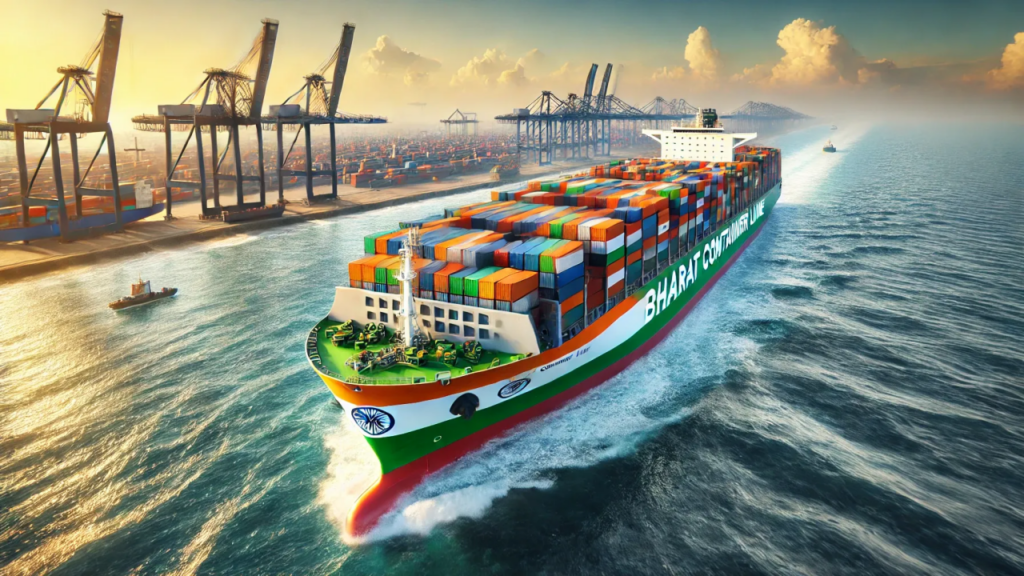
Bharat Container Shipping Line Takes Shape as Centre Signs Multi-Agency MoU
Summary
The Union Government has moved a step closer to launching the Bharat Container Shipping Line (BCSL) after a multi-agency memorandum of understanding (MoU) was signed under the Ministry of Ports, Shipping and Waterways. The MoU — signed in the presence of Union Ministers Sarbananda Sonowal (Ports, Shipping & Waterways) and Ashwini Vaishnaw (Railways) — brings together Shipping Corporation of India (SCI), Container Corporation of India (CONCOR), Jawaharlal Nehru Port Authority (JNPA), V.O. Chidambaranar Port Authority (VOCPA), Chennai Port Authority and Sagarmala Finance Corporation Limited (SMFCL).
The agreement operationalises aspects of the Container Manufacturing Assistance Scheme (CMAS) announced in the Union Budget 2026–27. In a parallel tripartite MoU, VOCPA, Indian Railway Finance Corporation (IRFC) and SMFCL agreed joint financing arrangements of up to ₹15,000 crore for eligible port capacity expansion projects — notably the Outer Harbour Project at Tuticorin — using a Hybrid Annuity Model under the Sagarmala Programme and PM Gati Shakti National Master Plan.
Key Points
- MoU signed to establish the Bharat Container Shipping Line (BCSL), aiming to anchor India’s container trade domestically.
- Participating agencies: SCI, CONCOR, JNPA, VOCPA, Chennai Port Authority and SMFCL under the Ministry of Ports, Shipping & Waterways.
- The move gives operational form to the Container Manufacturing Assistance Scheme (CMAS) from the 2026–27 Union Budget.
- A separate tripartite MoU (VOCPA, IRFC, SMFCL) enables joint financing up to ₹15,000 crore for port expansion projects, including Tuticorin Outer Harbour.
- Funding will largely follow a Hybrid Annuity Model and is aligned with Sagarmala and PM Gati Shakti infrastructure plans.
- Officials say BCSL is intended to reduce exporters’ and importers’ exposure to volatile freight rates and global supply disruptions.
Context and relevance
Why this matters: India has run a rapidly expanding trade profile and has lacked a strong national container carrier; that has left shippers exposed to sudden freight spikes and service uncertainty. The BCSL initiative seeks to build national capability across the container value chain: domestic container manufacturing, port capacity expansion, integrated port-rail linkages and a national carrier to compete on reliability and strategic presence.
For industry: port operators, rail logistics providers, freight forwarders, exporters/importers and investors in maritime infrastructure should watch this closely. The financing model (Hybrid Annuity) and the ₹15,000 crore funding envelope signal serious capital backing for capacity build-out; operational details (fleet size, commercial strategy, timeline) will determine the real impact on freight rates and market dynamics.
Why should I read this?
Short version — India’s trying to stop getting ripped off by wild freight swings. They’re building a home-grown container shipping setup, funding port capacity and pushing domestic container manufacturing. If you move stuff in or out of India, play in ports, or watch trade policy, this cuts to the chase. Read it so you know what might change next in rates, capacity and logistics planning.
Author note (punchy)
This is not a tinkering move. It’s a strategic push: state agencies, big ports and rail finance lined up, a Budget scheme to back container manufacturing, and a multi-thousand-crore funding plan. If implemented properly, it could shift bargaining power back towards Indian traders and port systems. Keep an ear out for the follow-up on fleet plans and commercial partnerships — that’s where the game begins.