
When Software Broke Nike’s Supply Chain
Summary
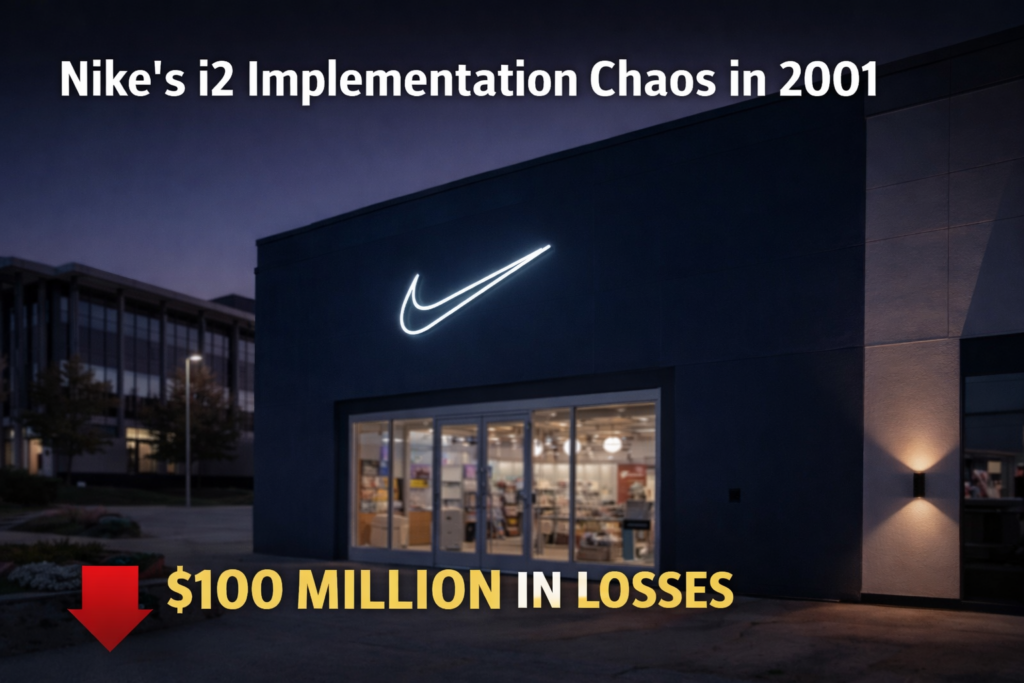
In 2001 Nike deployed a complex demand-planning system (i2) across its US and European operations in a big-bang rollout intended to replace spreadsheets and legacy tools. Integration with SAP and flawed data migration produced duplicated orders, bad forecasts and production signals that didn’t match reality. The result: excess inventory of slow-moving lines, shortages of hot sellers, heavy discounting, expedited shipments and about $100 million in losses — plus a near 20% hit to Nike’s share price during the crisis.
Key Points
- The i2 rollout at Nike was implemented in a “big bang” approach and lacked adequate phased testing or peak-demand simulations.
- Poor data quality and migration from legacy systems fed incorrect inputs into the planning algorithm — classic “garbage in, garbage out.”
- Software bugs and integration gaps with SAP caused duplicated orders and forecast errors, triggering overproduction for low-demand SKUs and stockouts for high-demand SKUs.
- Excess stock forced heavy discounting and tied up working capital; shortages required costly expedited air shipments and eroded retailer relationships.
- Market reaction was severe: Nike’s share price plunged nearly 20% in a week, showing direct financial exposure to supply-chain tech failures.
- Recovery relied on manual overrides, process fixes and moving to more robust systems — underscoring that tech without controls can scale failure as well as efficiency.
Context and relevance
This is a concise case study in why supply-chain digitisation can create new systemic risks if fundamentals are weak. As companies rush to adopt AI, real-time planners and advanced optimisation tools, the Nike episode is a reminder that integration, data hygiene and staged rollouts matter. For CIOs, supply-chain leads and planners, the story links directly to current trends: faster adoption of complex planning suites, increasing reliance on automated decisions, and the need to pair models with strong governance and human judgement.
Why should I read this?
Short version: it’s a brilliant wake-up call. If you’re buying or running planning software, this shows what goes wrong when IT, data and ops don’t talk — and how expensive “going fast” can be. Read it to avoid repeating the same costly mistakes.
Author style
Punchy: this isn’t theory — it’s a real-world faceplant. The takeaways are practical and urgent for anyone accountable for forecasting, integrations or rollout risk. If you manage tech that drives operations, the detail matters.
Source
Source: https://www.logisticsinsider.in/when-software-broke-nikes-supply-chain/