
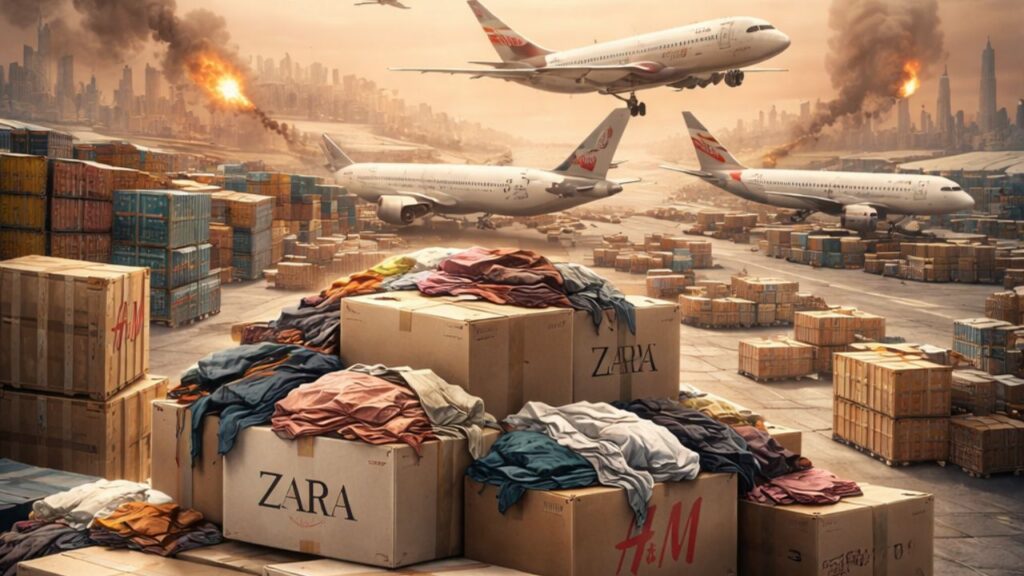
The War that Almost Broke “Just-in-Time” Delivery for Zara and H&M
Summary
Spring collections were late to European high streets in 2026 as Zara and H&M struggled to replenish stores on schedule. A sudden escalation of conflict in the Middle East led major Gulf carriers to cancel flights and close airspace, choking cargo routes that link South Asian production hubs to Europe. The disruption exposed how dependent fast fashion’s just-in-time model is on a small number of transshipment nodes — notably Dubai — and how little built-in redundancy those systems have.
Shipments from India and Bangladesh piled up at airports, transit times extended by 7–10 days, and brands were forced to use costly sea-air detours via Colombo and Singapore. Logistics costs spiked (reports of rises up to c.70%), contractual stress increased, and conversations about force majeure and renegotiated timelines proliferated across the chain. The episode underlines a strategic dilemma for fast fashion: maintain razor-speed operations, or pay for resilience.
Key Points
- Airspace closures and Gulf carrier cancellations centred on Dubai and other Gulf hubs halted key cargo corridors used by apparel exporters.
- India and Bangladesh were hit hard — more than 41% of India’s air cargo and over half of Bangladesh’s flows pass through Gulf hubs.
- Transit delays of around 7–10 days left racks understocked and disrupted fast fashion replenishment cycles.
- Workarounds such as sea-air via Colombo and Singapore moved freight but raised costs and transit times (cost increases reported as high as ~70%).
- The disruption forced suppliers, brands and forwarders to revisit contracts, force majeure clauses and commercial obligations.
- Longer-term shifts likely: route diversification, dual sourcing, nearshoring, and selective buffer inventory — all trading speed for resilience and higher costs.
Context and relevance
This incident is part of a pattern of shocks (pandemic, Suez blockage, now Middle East tensions) that repeatedly stress supply chains optimised for cost and speed. Fast fashion’s competitive edge rests on low inventory and rapid replenishment; when the transport layer fails, the business model shows its limits.
For supply-chain and retail professionals, the article highlights immediate vulnerabilities (single-node dependency, air-freight reliance) and realistic mitigation levers. Policymakers and logistics planners should note how geopolitical risk translates quickly into commercial and operational pain for global sourcing models.
Why should I read this?
Look — if you’ve wondered why Zara/H&M racks looked bare this spring or why delivery windows suddenly blew out, this piece explains it in plain terms. It’s short, explains the mechanics (Dubai as a choke-point, 7–10 day delays, expensive sea-air detours) and points to what brands will actually have to change. Good quick briefing if you work in retail, sourcing or logistics — or if you just like your jeans arriving on time.
Author’s take
Punchy and to the point: this isn’t just a logistics hiccup — it’s a strategic wake-up call. Firms chasing margin with ultra-lean flows will either accept higher disruption risk or start paying for redundancy. Read the detail if you care about the future of fast fashion or modern supply chains.