
The Hidden Cost of Slow Logistics in India Retail
Summary
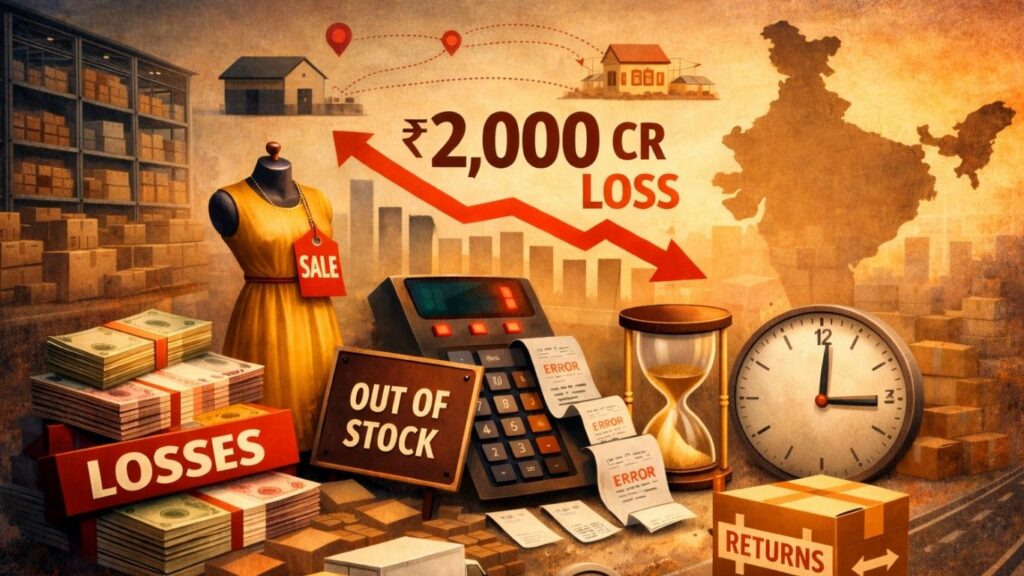
India’s retail sector is growing quickly with omnichannel models and improved customer-facing services. But a logistics-intelligence study across 48 omnichannel brands and 15,000+ stores reveals a hidden, structural inefficiency: slow internal inventory movement between warehouses, hubs and stores. This internal drag — not last-mile delivery — is costing the sector more than ₹2,000 crore a year and tying up large amounts of working capital during peak periods.
The article gives concrete examples (a 150-store fashion chain whose internal returns cycle stretched to 13 days, tying up ₹2.6 crore in a month) and sector-wide estimates: lost peak revenue of 8–12%, invoice discrepancy rates of 10–15%, 1,500 monthly disputes and teams wasting roughly 65 labour hours a day on resolutions. It argues that manual systems (emails, spreadsheets) run up to five times slower than automated alternatives, while modern WMS/TMS and AI-led planning can boost core operational efficiency by roughly 40–60%.
Key Points
- Internal logistics inefficiencies cost India retail > ₹2,000 crore annually (study of 48 brands / 15,000+ stores).
- The main bottleneck is internal inventory movement (warehouses → hubs → stores), not last-mile delivery.
- Peak-period internal pickup delays can immobilise nearly ₹200 crore in working capital across the sector.
- Example: a 150-store fashion brand saw return cycles balloon to 13 days, tying ₹2.6 crore in a month.
- Retailers may lose 8–12% of potential revenue during peaks because stock isn’t where demand is.
- Operational friction: 10–15% of invoices have discrepancies, causing ~1,500 disputes monthly and ~65 labour hours lost daily.
- Returns are expensive: processing a return can cost up to 1.5x the original delivery; fashion return rates 30–35% and COD rejections up to 26% amplify the pain.
- Manual coordination (emails, spreadsheets) is up to five times slower than automated systems.
- Adopting WMS, TMS and AI/ML routing and inventory planning can improve operational efficiency by ~40–60%.
- The new competitive edge is internal speed: how fast inventory moves within the network determines a retailer’s ability to respond to demand and scale.
Context and Relevance
This piece matters because retail competition is moving beyond customer-facing promises (fast delivery, wide assortment) to the invisible speed of internal operations. As product cycles compress (fashion cycles cut from ~90 to 15–20 days) and SKUs turn faster, slow intra-network logistics destroy capital, sales opportunities and profitability. For anyone running or investing in retail, supply chain, warehousing or logistics tech in India, the article pinpoints where value is leaking and where tech-driven interventions will have the biggest ROI.
Why should I read this?
Short version: if your business sells stuff in India or builds tech for retail logistics, this is the bit that quietly eats profits. It’s not sexy — it’s paperwork, pickups and returns — but fix it and you free up working capital, cut sales losses and stop people spending days on invoice fights. We read the heavy lifting for you; this is the quick map of the money-drain and what to do about it.
Author style
Punchy — the article punches through the hype around last-mile improvements and forces attention on the internal network. If you care about margins, growth or scalability, this piece makes a short, sharp case to prioritise automation and analytics now rather than later.
Source
Source: https://www.logisticsinsider.in/the-hidden-cost-of-slow-logistics-in-india-retail/