
How To Break Up With China
Summary
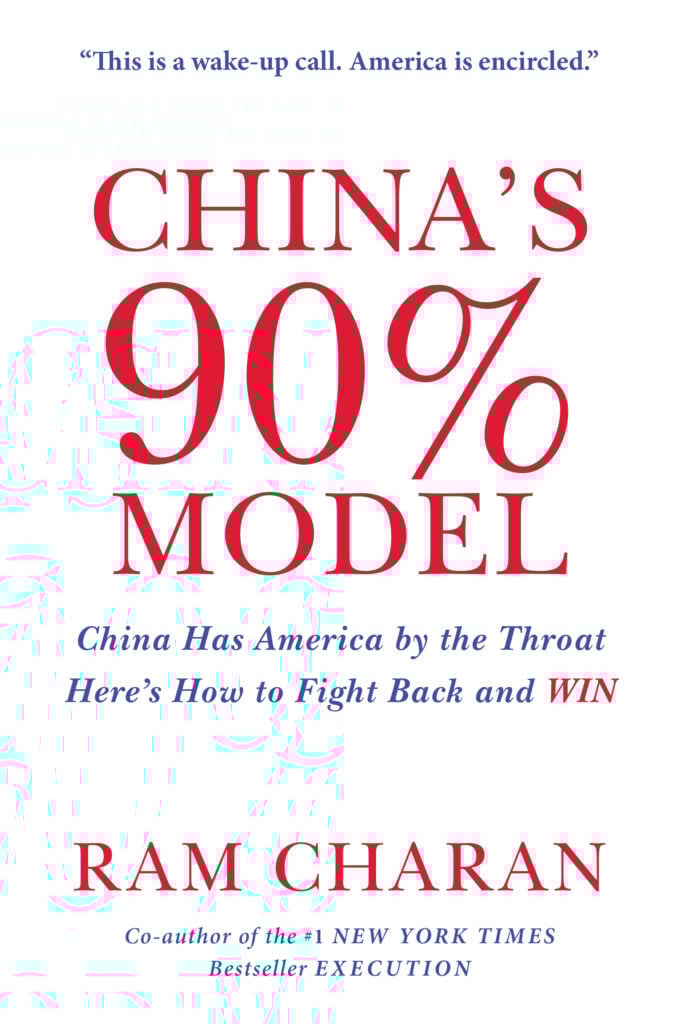
Ram Charan argues the U.S.-China economic contest is not a temporary trade spat but a long-term structural economic war in which companies are on the front lines. In an excerpt from his book China’s 90% Model, Charan gives CEOs and boards a practical, industry-by-industry playbook to extricate supply chains from China, rebuild trusted manufacturing capacity across the “American Sphere” and seize growth in the Global South. He sets a three-to-five-year timeline, lays out concrete steps for skills, equipment and capital, and warns that short-term margin pain is the price of strategic control.
Key Points
- The contest with China is framed as a structural economic war, not a simple trade dispute.
- Charan prescribes a coordinated allied response and a business-led extrication: build capacity across the American Sphere and invest in the Global South.
- A three-to-five-year migration plan is proposed: pilot lines Year 1, scale Years 2–3, and full diversification by Years 4–5.
- Industries highlighted for action include chemicals, critical minerals, pharmaceuticals, semiconductors, automobiles/EVs and telecom.
- Success requires capital, skilled labour, specialised equipment, diversified materials and credible communication with investors and boards.
- Companies must set visible milestones (25% reduction in Year 2, 50% in Year 3) to attract investment and credibility.
- Breaking China’s chokeholds (processing, refining, rare earths) demands large-scale, coordinated investment across trusted partners.
- Boards must ask hard questions now; delaying increases transition costs and strategic vulnerability.
Content Summary
Charan opens by telling CEOs that governments can create the conditions for change but cannot rebuild industries alone — that is the job of private enterprise. He outlines the narrowing window for a controlled withdrawal as tariffs, export controls and retaliations accelerate. CEOs and boards should immediately assess whether they have a focused China-exclusion strategy, transparent reporting, an executable transition plan, a war room to monitor warning signals, and frequent investor communications.
The plan is concrete: identify what you own (design, brand, distribution, capital), what you lack (manufacturing, tooling, skilled operators, critical components), and where to source it (Japan, Germany, South Korea, India, the U.S., regions in the Global South). Charan shows how a cellphone/laptop maker could pilot in India or Mexico, scale production, train local staff (including short-term Chinese experts), diversify suppliers and fully extricate in roughly three years.
He stresses two pillars for future growth: the Global South (fast-growing markets from India to Africa and Latin America) and the American Sphere (a $60 trillion industrial base of trusted partners). The excerpt covers industry-specific needs for chemicals, critical minerals, pharma, semiconductors, EVs and telecom and gives practical recommendations on skills, equipment, financing and timelines.
Context and Relevance
This is highly relevant to boards, CEOs and supply-chain leaders facing geopolitical risk. The piece maps a pragmatic route out of overdependence on China while identifying new markets and trusted partners. It aligns with recent moves — rare-earth refinery expansions, battery recycling projects, and government production orders — and places corporate strategy at the centre of national economic resilience. For organisations that depend on predictable supply chains, this excerpt is a wake-up call: act now or pay much more later.
Author style: punchy, direct and operational — aimed at leaders who must make hard choices. If you run or advise a company with exposure to China, the playbook is both a warning and a blueprint.
Why should I read this?
Look, if you’re responsible for revenue, supply chains or the next investor call, this is the sort of war‑room checklist you want stuffed in your pocket. It tells you what to ask, where to move first and what pain to expect — in plain language. No fluff. Just a clear plan for getting out of a risky dependence and finding new markets that actually grow.
Source
Source: https://chiefexecutive.net/how-to-break-up-with-china/