
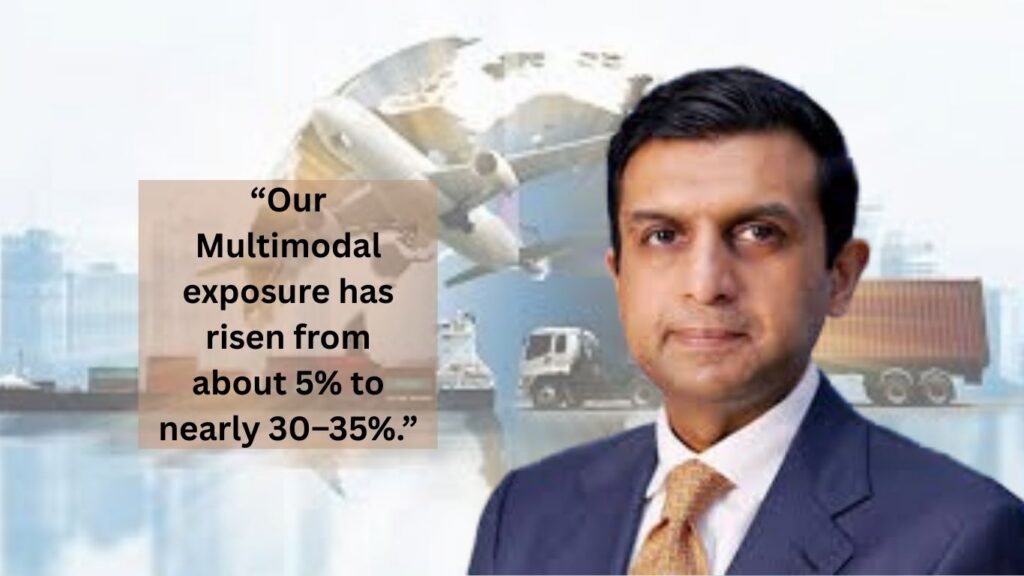
Our exposure to multimodal logistics has increased from about 5% to nearly 30–35% today: TCI’s Vineet Agarwal
Summary
Transport Corporation of India (TCI) has shifted significantly towards multimodal logistics over the last decade. Managing Director Vineet Agarwal says multimodal now accounts for roughly 30–35% of TCI’s business, up from about 5%. The company is investing in coastal shipping, rail rakes and upgraded warehousing to tap cost, speed and sustainability gains. Q3 FY26 saw PAT rise 13.4% on solid demand in Supply Chain Solutions and Seaways, though GST rate changes caused short-term market disruptions.
Author note
Punchy: This isn’t incremental tinkering — it’s a structural play. TCI is betting scale+integration will be the differentiator as India builds out rail, coastal and multimodal infrastructure.
Key Points
- TCI’s multimodal share rose from ~5% to ~30–35% of business in about ten years.
- Q3 FY26 profit after tax grew 13.4%, driven by Supply Chain Solutions and Seaways.
- Company is investing in coastal shipping capacity and additional railway rakes to scale multimodal offerings.
- GST rate revision created a short-term demand spike and channel pressure; normalisation expected as clarity returns.
- TCI is strengthening warehousing (IT, racking, operations) to serve quick commerce and omnichannel distribution needs.
- Multimodal adoption is framed as both cost-efficient and a route to lower carbon emissions — but mode-linkage (seamless transfers) remains a challenge.
- With infrastructure improving beyond metros, the logistics sector could grow about 1–1.5x GDP, creating sustained opportunity for integrated players.
Content Summary
Vineet Agarwal told Logistics Insider that TCI has deliberately reduced its dependence on road-only freight by expanding rail and coastal shipping services. The move is visible in the company’s financials — profit growth outpaced revenue in Q3 FY26 — and in active investments to increase multimodal capacity. Agarwal highlighted that policy shifts (notably the GST rate revision) temporarily distorted demand patterns but are settling as the market adapts.
Operationally, TCI is upgrading warehouses and IT systems to meet faster delivery expectations from quick commerce and omnichannel clients, while continuing to build the physical assets — rakes and coastal vessels — required for scale. The company frames multimodal as both an economic and environmental advantage, though seamless inter-modal connectivity still needs improvement.
Context and Relevance
Why this matters: India is investing in dedicated freight corridors, ports and coastal shipping — national infrastructure that makes multimodal logistics commercially viable at scale. TCI’s transition is an early signal that integrated freight models are moving from rhetoric to reality. For shippers, carriers and investors, the trend implies shifting cost dynamics, new capacity bottlenecks (rail/coastal slots vs road), and greater emphasis on hub-to-hub connectivity and warehouse tech.
Industry relevance: the piece ties corporate strategy to broader policy and infrastructure trends, and highlights short-term market effects of taxation changes — useful for logistics planners, supply‑chain strategists and investors tracking sector transformation.
Why should I read this?
Quick and real: if you work in logistics, shipping or supply‑chain strategy, this gives a fast, no-fluff snapshot of how a large Indian player is actually shifting its network. Think of it as senior management signalling where volumes — and margins — are likely to move next. Saved you the deep-dive: read this to know where to focus the next conversation with ops, procurement or your CFO.