
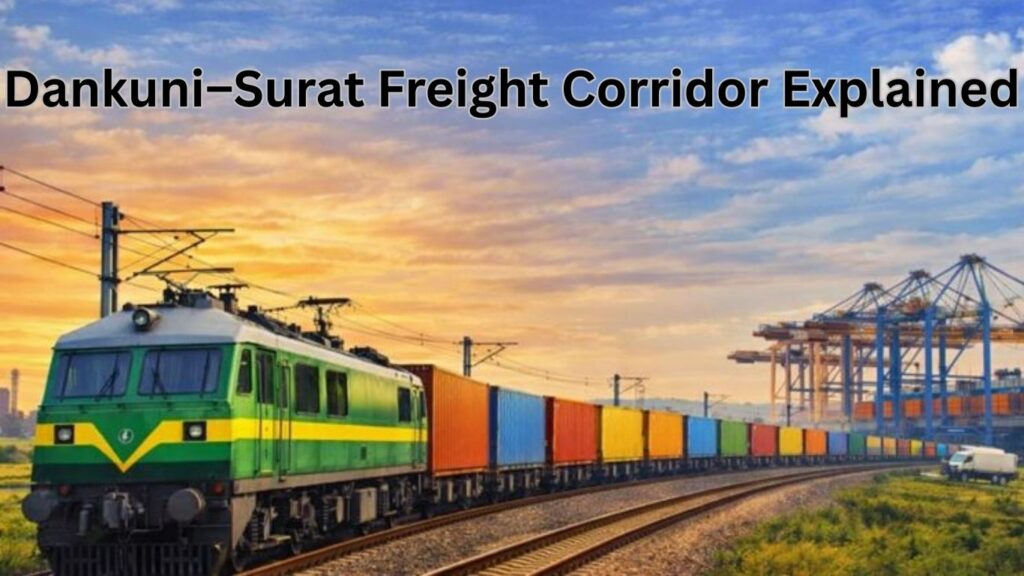
Budget 2026: Dankuni–Surat Freight Corridor Explained
Summary
The Union Budget 2026 introduced a new Dedicated Freight Corridor (DFC) running east–west from Dankuni (West Bengal) to Surat (Gujarat). Spanning about 2,052 km and cutting through Odisha, Chhattisgarh, Madhya Pradesh and parts of Maharashtra, the corridor aims to offer high-capacity, faster rail freight with heavier axle loads and integration into the existing Eastern and Western Dedicated Freight Corridors. The project is pitched to reduce logistics costs, decongest rail networks, and strengthen links between inland industry and west-coast ports while supporting greener cargo movement.
Key Points
- The Dankuni–Surat DFC is around 2,052 km and traverses key industrial states: West Bengal, Odisha, Chhattisgarh, Madhya Pradesh and parts of Maharashtra.
- Designed for heavy-haul operations: target speeds up to 100 km/h and axle loads around 32.5 tonnes to move bulk commodities more efficiently.
- Will integrate with the Eastern DFC and Western DFC to create a continuous national freight grid and a long-awaited east–west axis.
- Expected outcomes: lower transit times, reduced freight costs, decongestion of existing lines and a stronger route for exports via Maharashtra and Gujarat ports.
- Part of a wider rail capital expenditure push (approx. ₹2.77 lakh crore) and complementary to national waterways and coastal cargo initiatives to shift freight onto greener modes.
- Dankuni is set to develop as a larger logistics hub; the corridor could catalyse manufacturing and trade-led growth along its alignment.
Content Summary
The Budget announcement places infrastructure and logistics at the heart of India’s growth strategy by adding an east–west Dedicated Freight Corridor linking Dankuni and Surat. Railway authorities expect heavy-haul capability that will make rail more competitive with road for bulk commodities such as coal, steel and food grains. By tying into the Eastern and Western DFCs, the new line forms a crucial cross-country spine that eases port connectivity and export flows from eastern industry to western ports.
Beyond transport performance gains, the corridor is framed as a structural policy step toward an integrated, multimodal logistics ecosystem — reducing bottlenecks, lowering costs and improving supply-chain resilience. The government’s simultaneous emphasis on rail capex and coastal waterways positions the corridor within a broader push for greener and higher-capacity freight movement.
Context and Relevance
This corridor fills a long-standing gap: India’s DFC network has primarily been north–south and inward-looking; an east–west route materially improves national connectivity. For logistics professionals, port operators and manufacturers, the corridor promises quicker access to ports, steadier rake availability, and the potential to shift large volumes from road to rail — an outcome that can lower operating costs and carbon intensity across supply chains.
Regionally, South Gujarat manufacturers get faster links to eastern markets; for eastern India, Dankuni’s rise as a logistics hub could attract investment and industrial development. The announcement complements ongoing investments in rail infrastructure and modal-shift policy measures, making it a key development to track for trade, EXIM flows, and industrial planning.
Why should I read this
Short answer: if you move goods in India or plan to export from eastern factories, this matters. The corridor could seriously cut costs and transit times, unclog existing routes and change where companies decide to build factories and warehouses. It’s a practical infrastructure move that has real operational consequences — not just politics.
Author style
Punchy: The piece lays out the facts fast — route, capability, and the likely wins for trade and industry. If you care about logistics competitiveness or where India’s manufacturing map is going next, read the detail — it’s more than a line on a map.
Source
Source: https://www.logisticsinsider.in/budget-2026-dankuni-surat-freight-corridor-explained/