
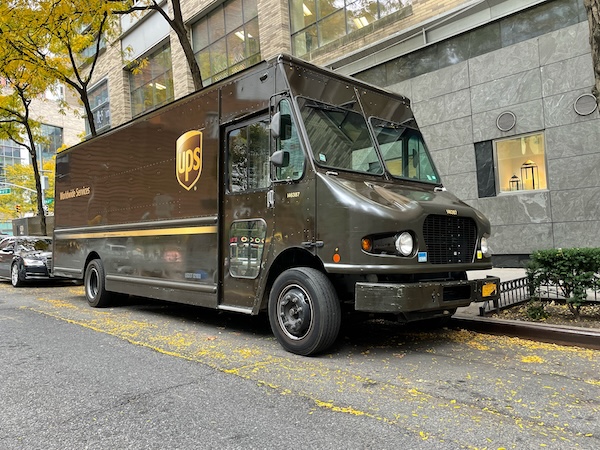
UPS sees 3.2% fourth quarter earnings decline
Summary
UPS reported fourth-quarter 2025 results showing a 3.2% year‑on‑year decline in revenue to $24.5 billion, with basic earnings per share of $2.38 (beating estimates of $2.20). Operating profit fell 12.0% to $2.6 billion. The quarter reflected continued volume declines in certain segments alongside gains in revenue per piece and a continued strategic shift toward higher‑quality revenue and cost containment.
Key Points
- Total revenue: $24.5 billion, down 3.2% year‑over‑year; EPS $2.38, above Street estimates.
- Operating profit: $2.6 billion, down 12.0% annually.
- U.S. Domestic Package: $16.7 billion, down 3.2% — but revenue per piece rose 8.3% to $13.27.
- International Package: $5.0 billion, up 2.5%; revenue per piece up 7.1% to $22.06.
- Supply Chain Solutions: $2.4 billion, down 15.0%, mainly due to Mail Innovations volume declines.
- GAAP charges of $238 million included a $37 million after‑tax write‑off of the MD‑11 fleet and $101 million in after‑tax transformation charges; MD‑11 retirement completed in Q4.
- Network actions: ~1 million fewer Amazon pieces per day in 2025, 93 U.S. buildings closed, automation deployed in 57 buildings, and $3.5 billion of savings from network reconfiguration and efficiency initiatives.
- 2026 outlook: consolidated revenue ~ $89.7 billion and operating margin ~ 9.6%; glide down of another ~1 million Amazon pieces per day planned for 2026.
- Strategic shift: UPS emphasises margin over volume — focusing on revenue quality, cost containment, automation and growing SMB/B2B share.
Content summary
Atlanta‑based UPS closed 2025 with mixed results: revenue slipped but profitability per share beat expectations thanks to pricing discipline and cost reductions. Segment performance varied — domestic volume declines were offset by higher revenue per piece, while international showed modest growth. Supply Chain Solutions was the weakest area, dragged by Mail Innovations.
Management highlighted structural moves: the ongoing Amazon glide‑down (approximately 1 million fewer pieces per day reduced in 2025 with another million planned for 2026), a push to reconfigure and shrink the network, and accelerated automation deployment. These actions produced material cost savings but also mean a deliberate reduction in overall volume. UPS renewed and adjusted its Ground Saver (formerly SurePost) arrangement with USPS to improve economics and will continue ramping that flow.
Analyst and industry commentary stresses the strategic implications: UPS is choosing margin over raw volume and is willing to walk away from unprofitable business. That shifts leverage toward carriers and raises the bar for shippers that lack scale or clean profiles.
Context and relevance
This is an important read for shippers, 3PLs and logistics planners because UPS’s strategy signals a broader industry shift: carriers are prioritising revenue quality and automation-driven efficiency over volume growth. Expect tighter pricing discipline, less willingness to accommodate low‑margin business, and growing importance for shippers to demonstrate profitability and scale in negotiations. The Amazon glide‑down and network right‑size also alter capacity dynamics and could influence transit times, rates and contract terms through 2026.
Why should I read this?
Quick heads up — UPS is reshaping how it wins and keeps business. They beat EPS but cut volume, shut buildings, and leaned hard into automation. If you ship parcels (especially e‑commerce or retailer volumes), this matters: pricing leverage is shifting, carriers are less likely to bend on low‑margin work, and operational changes will ripple through rates and service. Worth five minutes to see how your contracts and routing might be affected.
Author note
Punchy takeaway: UPS isn’t just trimming costs — it’s changing the playbook. For many shippers, that’s a strategic alarm bell.
Source
Source: https://www.logisticsmgmt.com/article/ups_sees_3.2_fourth_quarter_earnings_decline