
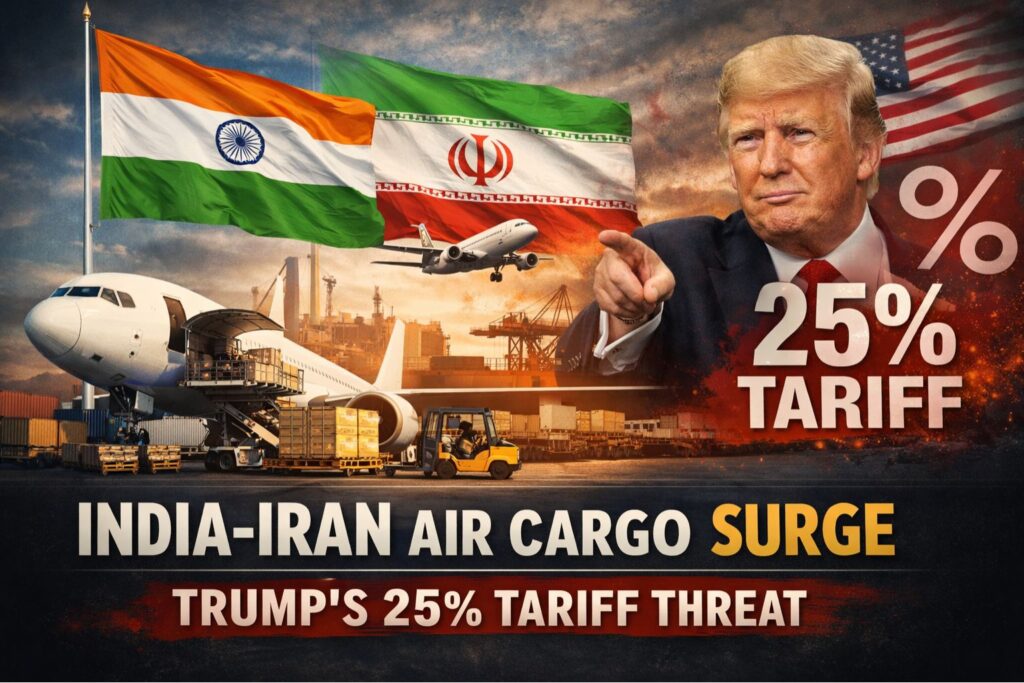
Why India’s Air Cargo Movement to Iran Has Nearly Doubled and Why It Matters Now
Summary
India’s air cargo volumes to Iran have roughly doubled since the early 2020s, crossing the 1,000-tonne mark in recent reporting. The shift is modal — more goods are moving by air rather than sea — driven by time-sensitive exports (notably pharmaceuticals, speciality chemicals and perishables), sanctions-related maritime and banking friction, India’s strategic engagement with Iran (including Chabahar), growth in India’s air-cargo infrastructure and exporters diversifying into steadier markets.
That rise now meets a geopolitical inflection point: a US proposal to impose tariffs (up to 25%) on countries trading with Iran. If implemented or enforced through secondary pressure, this policy would raise compliance, banking and insurance costs and force many Indian exporters and logistics providers to reassess routes, contracts and market strategy.
Key Points
- Air freight volumes from India to Iran have nearly doubled over five years, exceeding 1,000 tonnes annually.
- The increase is modal — a deliberate shift to air for high-value, time-sensitive goods (pharma, medical formulations, speciality chemicals, processed food).
- Sanctions and maritime frictions push smaller, high-value consignments to air cargo because it reduces touchpoints and unpredictability.
- India’s strategic ties with Iran (Chabahar) and improved domestic air-cargo capacity (freighters, cold-chain corridors) have enabled the growth.
- President Trump’s tariff proposal targeting countries that trade with Iran creates new risk: higher compliance costs, banking and insurance reluctance, and possible modal-cost pressure.
- Non-Iran-facing companies may face indirect exposure through group networks and supply chains, raising insurance and trade-finance premiums.
- Recommended actions for industry: map Iran exposure, stress-test contracts and pricing, engage banks/insurers early, and keep close dialogue with policymakers.
Why should I read this
Look — if you move medicines, chemicals, food or run an export biz with any links to the Middle East, this matters. It explains why suddenly more parcels are flying to Tehran instead of sailing, what a US tariff threat could do to your payments and insurance, and the quick fixes firms should run before things break. Short, sharp and useful — saves you the faff of digging through data yourself.
Author style
Punchy: The piece isn’t just a data note — it’s a wake-up call. Logistics and supply-chain leaders should treat the near-doubling of air movement not as an operational footnote but as a strategic signal. Read the detail if you want to anticipate policy shock rather than react to it.
Context and Relevance
Why it’s important: the story sits at the intersection of logistics, trade and geopolitics. It shows how sanctions and diplomacy reshape modal choices, not just prices. For Indian exporters, freight forwarders, banks and insurers, the development is a timely indicator that trade routes may be judged on geopolitical alignment as much as efficiency or cost.
Where it ties into bigger trends: rising trade compliance scrutiny, growth in pharma and cold-chain air exports from India, and the broader push for supply-chain resilience and market diversification (Africa, SE Asia, Latin America) if Iran-linked exposure becomes a liability.