
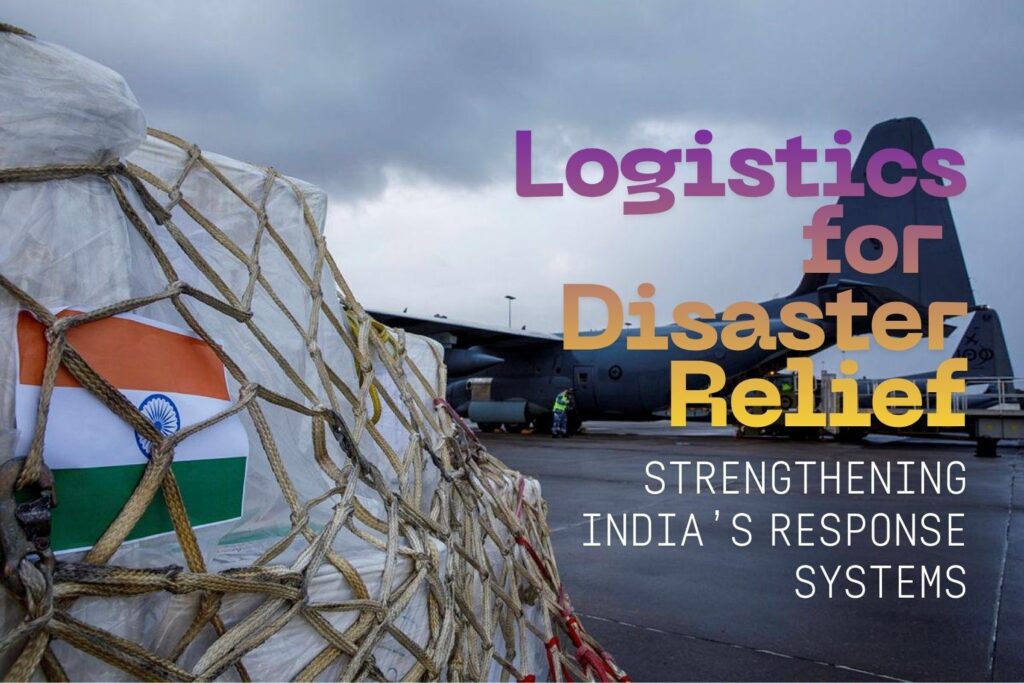
Logistics for Disaster Relief: Strengthening India’s Response Systems
Summary
India is shifting its disaster-relief logistics from reactive, ad-hoc responses to a more predictive, technology-driven model anchored by the National Disaster Management Authority (NDMA). The article highlights recent practical deployments — notably drone deliveries of 300 kg of supplies to isolated hamlets in Himachal Pradesh and Uttarakhand following the 2025 monsoon floods — enabled by NDMA’s updated Standard Operating Procedures for drone use.
Key developments include stronger federal–state coordination through NDMA/SDMAs, wider use of ISRO satellite data for early warnings, investment and funding mechanisms (including a large NDMA corpus and INR disbursements to states), public–private partnerships for surge capacity, and new tech tools such as AI-driven pre‑positioning, hyper-local risk mapping, blockchain for transparency and drones for last-mile delivery.
Key Points
- NDMA remains the national coordination hub with five focused divisions: Policy & Planning, Mitigation, Preparedness, Response and Capacity Building.
- Drone SOPs and rapid drone deliveries are now operational in disaster zones, improving access to cut-off communities.
- The disaster-relief logistics market is projected to grow at a 7.3% CAGR (2025–2035), driving private‑sector interest and PPPs.
- NDMA manages a substantial disaster risk reduction fund (reported corpus > USD 28 billion) and disbursed large state allocations in 2025 to pre-stock essential kits.
- Technology is central: ISRO satellites for early warning, AI for pre-positioning supplies, and blockchain for supply transparency.
- Public–private coordination is being institutionalised (suggestions include a ‘Disaster Logistics Corps’ of vetted firms with pre-approved contracts).
- Indigenous R&D and manufacturing have markedly reduced import dependence for critical gear (seismic sensors etc.).
Context and Relevance
Climate extremes and frequent seismic activity make efficient logistics for disaster response a national priority. With 59% of land earthquake-prone, severe monsoon floods and cyclones hitting states such as Assam and Odisha, faster and fairer delivery of aid is essential to save lives and reduce economic losses. The article situates India’s progress — policy, funding, tech adoption and PPPs — within global best practice and recent high‑impact responses of 2025.
Author style
Punchy: This piece cuts through the noise — it’s a practical snapshot of how policy, money and tech are finally aligning to make relief logistics faster and more reliable. If you work in supply chain, emergency planning or government, it amplifies why the detail matters right now.
Why should I read this?
Quick and useful — read it if you want the lowdown on what’s actually changing in India’s disaster logistics: drones that work, NDMA rules that matter, where the money is going, and how private firms are being roped in. It saves you time by pulling policy, tech and field examples into one short, actionable update.