
2025 U.S. Governance Post-Season Review: Evolving Priorities in a Shifting Landscape
Summary
The 2025 U.S. proxy season saw notable shifts in investor and corporate behaviour amid political, legal and regulatory change. Director election support generally recovered from pandemic-era troughs, with investors signalling renewed favour for traditional skills and longer tenure in some cases. Meanwhile, shareholder proposal activity dropped sharply — particularly environmental and social proposals — and nearly a quarter of submissions were omitted, largely due to SEC guidance requiring a clear nexus to a company’s core business. Governance-focused proposals dominated votes that received majority support.
Key Points
- Political, legal and regulatory changes reshaped the governance landscape and influenced DEI and sustainability initiatives.
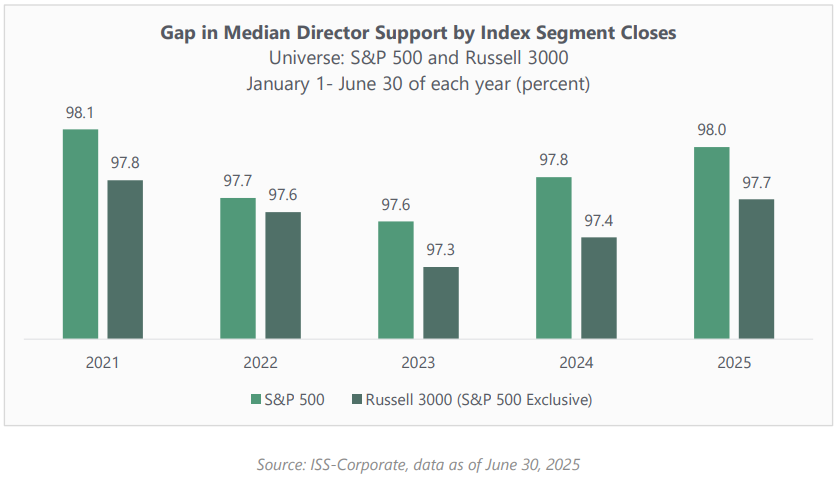
- Investor support for director elections rose overall, narrowing gaps between indexes.
- Boards favoured more traditional skills (leadership, finance, CEO experience); newer technical skills and ESG experience were less emphasised for incoming directors.
- Directors with multiple outside board commitments declined in number, even as vote support for overboarded directors ticked up slightly.
- Investor tolerance for long-tenured directors appears to be increasing, with the biggest gains for 20+ year incumbents.
- Shareholder proposal volume fell, E&S proposals declined most, and governance proposals (especially shareholder-rights measures) dominated successful votes.
- Nearly 24% of submitted proposals were omitted — SEC SLB No. 14M (CF) requiring a clear business nexus was a key factor.
- DExit (reincorporation from Delaware) attracted attention but relatively few management proposals proceeded.
- AI oversight grew in prominence; board skills and oversight of AI remain on investors’ radars.
- Shareholder engagement became more fraught after SEC guidance on Schedule 13D/G filings, with some investors pausing active engagement.
Content summary
Director elections: Support for directors rebounded from low levels seen in 2023. Governance committee and sustainability committee chairs still attract below-average support, but the overall picture improved. Although median support rose for directors serving on multiple public boards, the total number of such overboarded directors fell significantly, indicating boards are responding to investor concerns about bandwidth.
Board composition: Newly elected directors skewed older and more conventional in skillset, emphasising leadership and financial expertise over tech and ESG credentials. The pace of appointing racially, ethnically and gender diverse new directors slowed compared with prior peaks. Independent board chairs continued to become more common.
Shareholder proposals: Submissions dropped markedly, especially on environmental and social topics. Governance proposals remained the most prevalent and most successful; 45 of 50 resolutions that achieved majority support concerned governance. Omission rates jumped, influenced by the SEC’s reinstated nexus requirement. Special meeting proposals were frequent, though proposed changes to one-year holding rules drew little support.
DExit and legal domicile: Reincorporation away from Delaware drew headlines but only a small number of management proposals followed through, with Nevada the most common alternative destination in 2025.
AI and oversight: Interest in AI oversight rose, with more companies disclosing board-level oversight mechanisms. The trend toward traditional board skills may leave gaps in readiness for AI and other technology-driven risks.
Engagement: SEC guidance around Schedule 13D versus 13G raised concerns about whether certain shareholder communications could be seen as influencing control, causing some investors to scale back direct engagement. Boards should still prioritise documenting outreach and engagement efforts, particularly where vote support is weak.
Context and relevance
This review matters if you work in corporate governance, investor relations, board services or legal counsel. It captures how regulatory shifts and investor priorities are actively reshaping board composition, the types of shareholder proposals that gain traction, and how companies approach shareholder engagement and disclosure. The findings reflect broader trends: a tilt back towards traditional governance skills, rising scrutiny of board time commitments, and a governance-heavy proxy agenda driven by legal and procedural changes.
Why should I read this?
Short and blunt: if you’re involved with boards, IR, or governance policy, this saves you the legwork. It tells you what investors actually voted for in 2025, what proposals got blocked, where director hiring trends are going, and why the SEC’s rules matter for your proxy season planning. Read it so you’re not caught off guard next year.
Author style
Punchy — the analysis cuts to what trustees, governance teams and advisors need to know. If governance outcomes affect your business, this is essential reading; it flags practical implications and where to focus engagement and disclosure efforts.