
Effective Board Leadership: The Art of Doing It Well and the Risks of Getting It Wrong
Summary
Exceptional boards are the product of intentional, skilled leadership. PwC (in collaboration with Stanford) outlines how board chairs, lead directors and committee chairs must combine strategic foresight, emotional intelligence and a relentless focus on the organisation’s long-term health to turn oversight into value creation.
The paper sets out eight core attributes of outstanding board leadership and provides practical examples of what great — and poor — behaviours look like in practice. It covers role clarity (chair vs CEO vs lead director), agenda and strategy alignment, board‑CEO dynamics, psychological safety, board composition and refreshment, stakeholder engagement and crisis leadership.
The authors urge continuous improvement: structured assessments, independent reviews, 360° feedback and self‑reflection are essential to move from “good enough” to truly great governance. Where leadership is weak, they recommend timely action via the nominating/governance committee, clear role descriptions and, when necessary, leadership change.
Key Points
- Outstanding board leaders blend judgment, emotional intelligence and time commitment to unite directors around long‑term strategy.
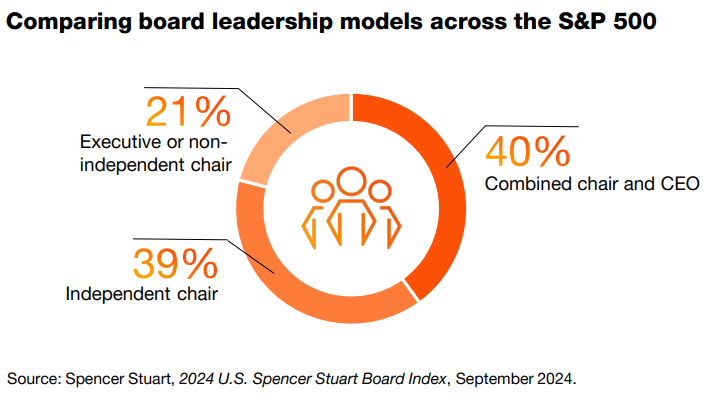
- There are multiple leadership models (combined chair/CEO, independent chair, lead director); regardless of model, governance duties must take priority.
- Eight attributes define effective board leadership: strategic foresight, stewardship of board culture, clear board‑CEO boundaries, inclusivity, disciplined agenda management, talent alignment and refreshment, stakeholder engagement and crisis stewardship.
- Practical behaviours include preparing thoroughly, promoting diverse perspectives, coaching the CEO, and using KPIs to monitor long‑term progress.
- Boards should treat governance as a living system and adapt structures and processes to match strategic needs.
- Regular, robust assessments (including independent reviews and 360° feedback) are key to diagnosing gaps — but are underused in practice.
- Succession and refreshment matter: leaders typically peak after 3–5 years and boards should consider changes after 8–10 years to avoid stagnation.
- When leadership issues arise, use quiet consensus‑building, the nominating/governance committee and formal assessments to justify and manage change.
- Clear role descriptions and feedback loops provide objective bases for development or replacement of underperforming directors or leaders.
- Effective crisis leadership requires composure, timely information, scenario planning and adaptive board processes.
Context and relevance
This article is timely for directors, company secretaries, investors and governance advisers. In an era of heightened stakeholder scrutiny, rapid disruption and shorter CEO tenures, the board is often the enduring institution tasked with safeguarding long‑term value. The guidance connects to ongoing trends: increased demand for board accountability, calls for refreshment and diversity, and greater investor focus on how boards manage strategy, risk and culture.
For practitioners, the piece offers a compact framework and actionable levers — from clarifying role descriptions to deploying independent evaluations — that can be applied immediately to strengthen governance and reduce the risks of costly failures.
Why should I read this?
Short answer: if you’re involved in governance, this is a practical playbook. It’s not fluffy theory — it tells you what good looks like, where most boards trip up and what to do about it. Read it to save time, avoid mistakes and get straightforward prompts on assessments, succession and crisis playbooks.