
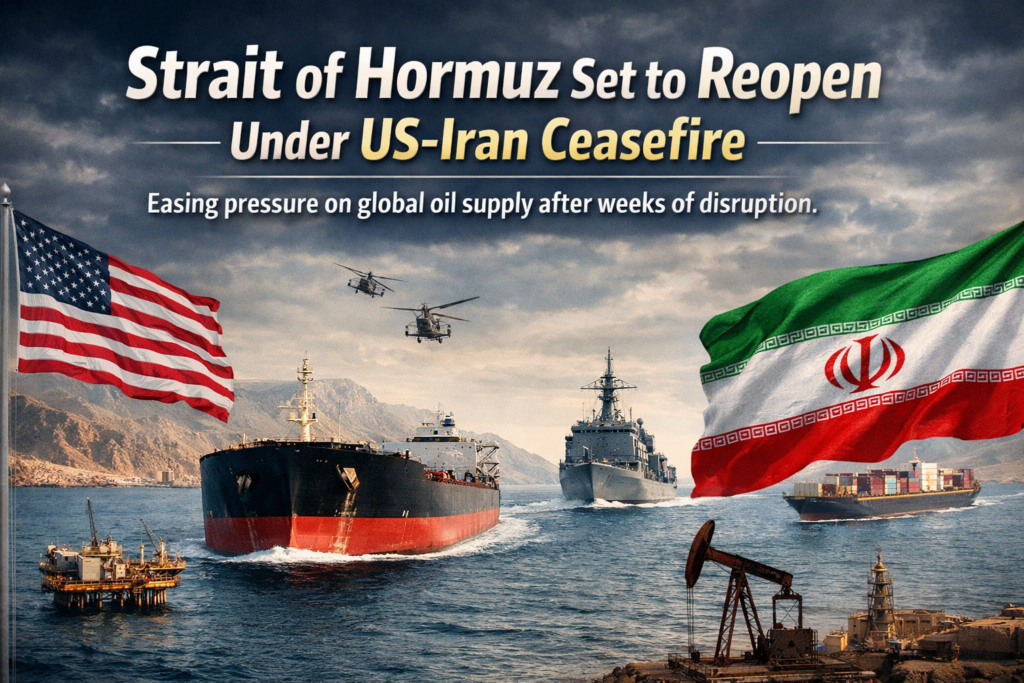
Ceasefire Clears Path for Hormuz Strait Reopening
Summary
A tentative two-week ceasefire between the US and Iran includes a disputed provision that would permit Iran and Oman to levy transit fees on vessels using the Strait of Hormuz, a chokepoint responsible for almost a fifth of the world’s oil shipments. The Strait, about 34 km wide, lies within the territorial waters of Iran and Oman but has historically been treated as an international passage with no tolls. Iran says any fees could fund post-conflict reconstruction after damage to infrastructure during the recent confrontation. The deal conditionally reopens the route after it had effectively remained closed since attacks on commercial vessels from 28 February, which pushed global oil prices higher.
Further diplomacy is expected: fresh talks involving the US and Israel are scheduled in Islamabad, and Iran and Oman are reportedly working on a protocol outlining variable fees by vessel type and cargo. Gulf states such as the UAE and Qatar have opposed imposing charges tied to passage. Under UNCLOS, coastal states cannot charge for innocent passage through international straits, though limited, non-discriminatory service fees (e.g. piloting) are allowed.
Key Points
- The ceasefire conditionally reopens the Strait of Hormuz after a closure triggered by attacks on commercial vessels.
- A contentious clause would allow Iran and Oman to impose transit fees, potentially varying by vessel type, cargo and conditions.
- The Strait handles nearly 20% of global oil shipments and is vital for other commodities such as fertilisers.
- Iran frames fees as a way to fund post-war reconstruction; the UAE and Qatar oppose any tolls that limit open navigation.
- UNCLOS restricts coastal states from levying passage charges through international straits; only limited, non-discriminatory service fees are permitted.
- Further negotiations and diplomatic talks are planned, with a two-week window aimed at finalising a broader agreement.
Why should I read this?
If your business ships fuel, fertiliser or relies on steady ocean routing, this matters. The reopening is good news — but the transit-fee idea could add new costs or force re-routing. Read the short summary so you know whether to check contracts, insurance and routing plans. Seriously: two weeks can change freight rates and supplier decisions. Don’t get caught off-guard.
Context and relevance
For logistics, shipping and energy sectors the story is significant. The Strait of Hormuz is a strategic artery; any change to its legal or economic regime affects freight costs, insurance premiums and routing choices globally. The proposed fees — if pursued — would represent a shift in how coastal states seek revenue from strategic passages and could prompt legal challenges under international law. For import-dependent economies and companies with time-sensitive cargo, the potential for renewed disruption or added charges makes this a developing risk to monitor closely.
Author style
Punchy: this is not just another geopolitical bulletin. For logistics pros the piece flags a possible structural change to a key shipping lane. If you manage routes, fuel budgets or supplier resilience, the details here deserve a follow-up — fast.
Source
Source: https://www.logisticsinsider.in/ceasefire-clears-path-for-hormuz-strait-reopening/