
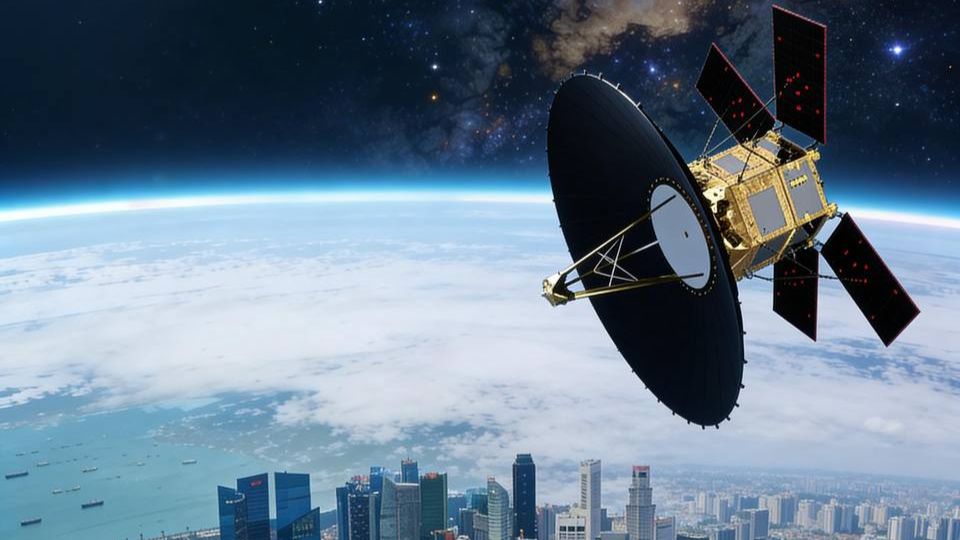
National Space Agency of Singapore established to improve connectivity and enhance climate monitoring & disaster response
Summary
Singapore launched the National Space Agency of Singapore (NSAS) on 1 April 2026 to lead the country’s expansion into the space economy. The agency will develop and operate national space capabilities, strengthen R&D, grow the local space industry, advance international partnerships, and craft pro-innovation regulations that also ensure space safety and sustainability.
NSAS and the Office for Space Technology & Industry will drive the next stage of Singapore’s space strategy via three thrusts: growing the local space sector, building international partnerships, and developing focused space programmes. The government highlights opportunities in satellites, data services, high-end manufacturing and services to improve connectivity, climate monitoring and disaster response.
Key Points
- NSAS was established on 1 April 2026 to provide national leadership in the space sector.
- Main mandates: develop national space capabilities, boost R&D, grow industry, deepen international ties, and update pro-innovation regulations.
- Three strategic thrusts: expand the space sector, forge partnerships, and run focused space programmes.
- Singapore already hosts about 70 space companies and roughly 2,000 professionals across the value chain.
- NSAS aims to leverage Singapore’s strengths (aerospace, microelectronics, precision engineering, AI) to support satellites, data and services despite limited land and launch facilities.
- International collaborations include agencies such as ESA, IN-SPACe (India), the UAE Space Agency and Thailand’s GISTDA.
- The global space economy is projected to reach around US$1.8tn by 2035 — NSAS positions Singapore to capture a slice of that growth.
Context and Relevance
The creation of NSAS signals Singapore’s move from a niche player to a coordinated national actor in space technologies. For businesses, it means greater access to government-backed R&D, talent pools and regional networks. For policymakers and industry, NSAS centralises strategy and regulation — smoothing pathways for commercial activity while emphasising sustainability and safety in orbital operations.
Practically, space-enabled services (satellite communications, Earth observation, climate monitoring and disaster response) can directly strengthen national resilience and commercial competitiveness — especially for a compact city-state that must rely on data and services rather than launch infrastructure.
Why should I read this?
Short answer: because this changes the game for tech, manufacturing and data people in Singapore. If you work in telecoms, AI, environmental monitoring, precision engineering or start-ups looking for overseas partners, NSAS will matter — funding, regulation and partnerships are all getting a fresh national push. We read the full piece so you don’t have to; this is the quick lowdown with the bits that affect strategy, hiring and investment.