
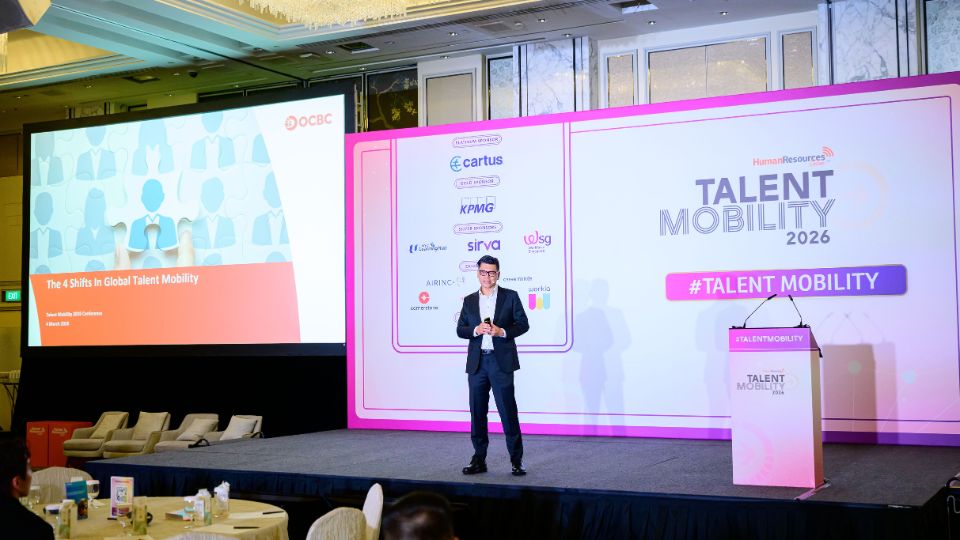
The 4 shifts in global talent mobility every HR leader needs to track, as shared by OCBC’s Joel Leong
Summary
At HRO’s Talent Mobility 2026, Joel Leong (Head of Talent and Performance Management, OCBC) reframed talent mobility as a strategic capability rather than a logistics function. He outlined four shifts HR leaders must track as megatrends — geopolitics, AI disruption, economic volatility and sustainability — reshape how organisations deploy skills across borders.
Leong’s four shifts: 1) Reframing the purpose of mobility from simple relocation to moving and growing capabilities for business needs and talent development; 2) Reimagining ‘place’ as hybrid, digital and location-agnostic work changes where and how skills flow; 3) Redefining the practice by demanding better measures of impact and value beyond cost and completion; 4) Refocusing on the assignee, recognising human factors (family, identity, stress) as central to assignment success.
Key Points
- Mobility’s purpose is shifting: it serves both organisational needs (fill skill gaps, market expansion, knowledge transfer) and talent development (leadership pipeline, succession, retention).
- Global mobility flows have slowed (BCG: ~8.5% YoY), but certain corridors—US and UAE—remain strong; AI talent still concentrates in the US with the UAE rising as a hub.
- ‘Place’ is being redefined: digital nomadism, hybrid work and virtual deployment mean capability can be moved or scaled without physical relocation.
- Mobility teams must prove impact: common metrics (cost, completion) are insufficient; measure assignment success, employee experience and alignment to strategic purpose while avoiding Goodhart’s Law.
- Human factors drive assignment outcomes: family adjustment, identity disruption and stress often cause failures—flexible models and empathy are essential.
- Organisations should treat mobility as a strategic lever—build frameworks that balance business imperatives with employee wellbeing to enable sustainable growth.
Context and Relevance
Leong’s talk reflects broader trends HR leaders are facing: geopolitical shifts that change talent corridors, rapid AI-driven skills demand, tighter economic constraints and rising expectations around employee experience and sustainability. For mobility and HR teams, this means rethinking policy, metrics and operating models so mobility supports strategic capability-building rather than just filling seats.
Why should I read this
If you deal with international assignments or global teams, this is a short, sharp reboot for how you think about mobility. Joel lays out practical angles — from metrics to family support to the idea that ‘place’ might be virtual — so you can stop firefighting logistics and start designing mobility that actually grows skills and keeps people sane.
Author style
Punchy: the piece cuts through the usual mobility checklist and forces leaders to up their game. If you care about talent strategy, read the detail — it’s a useful nudge to move mobility from admin to strategic advantage.