
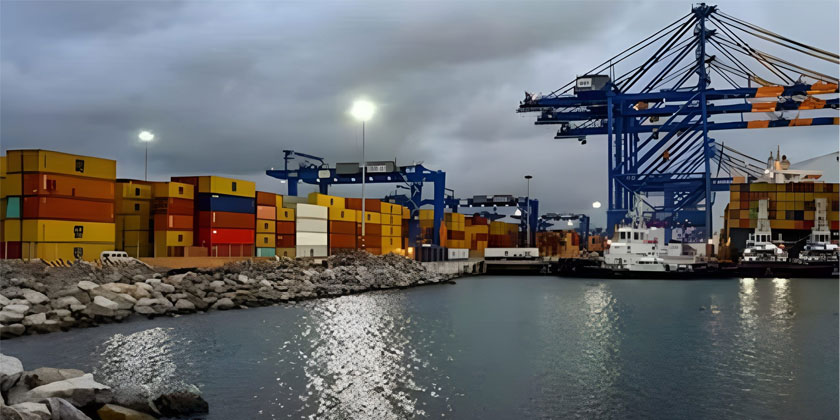
Sonowal Launches ₹1,500 Crore Green and Infra Push at VOC Port
Summary
Union Minister Sarbananda Sonowal inaugurated and laid foundation stones for projects totalling over ₹1,500 crore at V.O. Chidambaranar (VOC) Port, Tamil Nadu. Completed works worth around ₹160 crore focus on operational efficiency and sustainability, while foundation projects worth about ₹1,340 crore target renewable energy, shipbuilding, rail upgrades and greener harbour operations. The programme includes renewable generation, energy storage, green hydrogen, digital platforms and port-side industrial investments aimed at cutting vessel turnaround and logistics costs.
Key Points
- Total announced investment: ~₹1,500 crore split into completed works (~₹160 crore) and new projects (~₹1,340 crore).
- Completed upgrades: enhanced rail and road connectivity, integrated solar/wind/battery power systems, safety infrastructure, digital platforms including a digital twin, and a maritime heritage museum.
- Major foundation projects: an 8 MW wind farm with 5 MW storage, 2 MW green hydrogen facility, and a 2 MW ground-mounted solar plant.
- Additional investments: smart energy management, ₹131 crore for rail infrastructure, ₹250 crore for shipbuilding equipment and ₹367 crore for green tugs.
- Objectives: reduce vessel turnaround time, lower logistics costs, strengthen VOC Port as a regional transshipment and shipbuilding hub, and spur industrial growth in Thoothukudi, Tirunelveli and Madurai.
- VOC Port leadership emphasises port-led industrialisation and green innovation as drivers of sustainable regional development.
Content Summary
The visit combined inaugurations of finished works that immediately boost cargo handling and safety with the laying of foundation stones for larger strategic projects. The renewables and storage projects are designed to provide cleaner, more reliable power on-site and reduce the port’s carbon footprint. Investments in shipbuilding equipment and green tugs signal a push to add higher-value maritime activity locally, while rail and road upgrades improve hinterland evacuation to speed exports and transhipment flows.
The package is clearly aligned with a broader maritime roadmap: decarbonisation, digitalisation and making ports catalysts for regional industrial clusters. Expected near-term outcomes include shorter vessel stays, reduced logistics costs for exporters/importers, and fresh impetus for related industries along the Tamil Nadu supply chain.
Context and Relevance
For logistics and maritime stakeholders, this is a noteworthy regional investment that intersects several prevailing trends: port electrification and renewables, adoption of digital twins and smart energy systems, local shipbuilding capacity and modal connectivity (rail/road). If implemented on time and integrated with hinterland logistics, VOC Port’s upgrades could improve competitiveness for South Indian exporters and attract ancillary manufacturing and repair yards.
Author’s take
Punchy: This isn’t just ribbon-cutting — it’s a strategic nudge. The mix of green power, storage, hydrogen and shipbuilding kit shows the port authority wants to move up the value chain, not just handle more boxes. If you work in shipping, logistics, energy or regional industry planning, the detail matters because these projects change cost and capability equations in the region.
Why should I read this?
Look — if you care about faster ship turns, cheaper energy at the quay or new shipbuilding business in South India, this is the kind of development that actually moves the needle. It packs renewables, rail fixes and equipment money into one package, so it’s worth a quick skim even if you’re not based locally. Saves you the time of reading the full press rollouts and tells you what will affect port ops and regional logistics soon.