
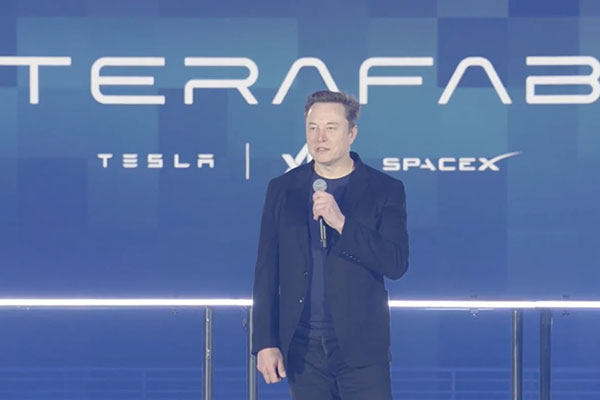
Elon Musk Announces Plans For $25 Billion Chip Project in Austin, Texas
Summary
Elon Musk unveiled “Terafab,” an integrated semiconductor project planned on the North Campus of Giga Texas. Backed by Tesla, SpaceX and xAI, the facility is expected to cost between $20 billion and $25 billion and aims to combine design, fabrication, memory, packaging and testing under one roof. Tesla is targeting 2-nanometre process technology and an ambitious production goal of roughly one terawatt of compute per year — about 100 million to 200 million AI chips annually. Terafab will produce terrestrial AI chips (including Tesla’s next-generation AI5 for Full Self-Driving, robotaxi and Optimus humanoid robotics) and radiation-hardened processors for space systems. Early production for the AI5 chip is targeted for late 2026. Tesla’s CFO said the investment is not yet included in current capital spending plans.
Key Points
- Terafab is a $20–25 billion integrated chip project announced for Austin, Texas, located at Giga Texas’ North Campus.
- The project is a joint effort backed by Tesla, SpaceX and xAI (recently acquired by SpaceX).
- Facility scope: end-to-end chip work — design, fabrication, memory, packaging and testing under one roof.
- Target technology: 2-nanometre process nodes aimed at advanced AI workloads.
- Ambitious production target: ~1 terawatt of compute per year (estimated 100–200 million AI chips annually).
- Two main chip families: terrestrial AI chips for Tesla products (AI5) and radiation-hardened processors for orbital/space systems.
- AI5 early production is expected in late 2026; large-scale ramp and capital spending timing remain uncertain.
- Musk suggested up to 80% of compute output could serve orbital AI systems, citing energy and thermal advantages in space.
- The announced investment is not yet part of Tesla’s existing capital expenditure plans (which already exceed $20 billion).
Context and Relevance
This announcement touches many trends: chip supply-chain reshoring, vertically integrated manufacturing, and a convergence of automotive, robotics, AI and space computing needs. For supply-chain and manufacturing teams, Terafab would create demand for specialised equipment, materials and local workforce skills — and it would shift regional supplier networks. For technology and AI stakeholders, a 2nm-capable, onshore source of high-volume AI chips could reduce reliance on external foundries and influence global chip allocations. For investors and policymakers, the scale of the project signals another major US-based semiconductor bet coming out of the private sector.
Why should I read this?
Short version: if you care about chips, AI, cars, robots or space, this could change where the compute gets made. It’s a huge bet — and it matters for supply chains, jobs and who controls large-scale AI hardware. We’ve skimmed the detail so you don’t have to, but this one’s big enough to keep an eye on.
Author style
Punchy: big numbers, big ambition. This isn’t a routine factory update — it’s a potential game-changer for onshore semiconductor capacity and for how Musk’s companies source critical AI hardware. If your role touches procurement, manufacturing or AI deployment, the full details are worth a read.
Article Meta
Article Date: 2026-03-25T10:04:00-04:00
Article URL: https://www.supplychain247.com/article/musk-terafab-chip-factory-austin-texas-ai-supply
Article Image: https://www.supplychain247.com/images/2026_article/elon-musk-terafab-600.jpg

Source
Source: https://www.supplychain247.com/article/musk-terafab-chip-factory-austin-texas-ai-supply