
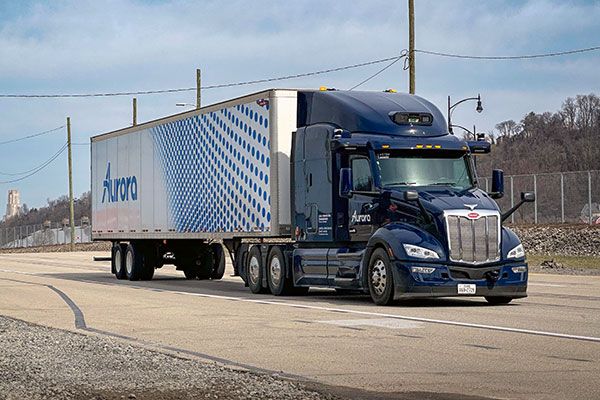
Aurora Study Finds Autonomous Trucks Could Save $9 Billion Annually
Article Date: 2026-03-25T09:52:00-04:00
Article URL: https://www.supplychain247.com/article/aurora-study-finds-autonomous-trucks-could-save-9-billion-annually
Article Image: 
Summary
Aurora Innovation commissioned a new report projecting that autonomous trucking could deliver substantial economic and social benefits by 2035. The study estimates up to $70 billion added to U.S. GDP and around $9 billion in annual consumer savings driven by lower transportation costs.
The report also forecasts about $5.7 billion a year in fuel savings and roughly $9.4 billion in safety-related benefits from fewer crashes, injuries and fatalities. Aurora highlights that autonomous trucks could help address a projected driver shortage of up to 1.2 million drivers over the next decade, enabling a more “always-on” supply chain with longer operating hours and improved efficiencies.
Aurora says the sector already supports about 17,000 jobs and $3.3 billion in economic output today and announced a $1 million Aurora Works workforce programme to train workers for roles tied to autonomous freight. The findings are based on adoption scenarios and assume broader deployment over the coming years; large-scale roll-out remains early-stage.
Key Points
- The study projects autonomous freight could add up to $70 billion to U.S. GDP by 2035.
- Consumers could see approximately $9 billion in annual savings through lower transport costs.
- Estimated annual fuel savings of $5.7 billion and safety benefits worth about $9.4 billion.
- Autonomous trucks may help mitigate a forecast driver shortage of up to 1.2 million drivers over the next decade.
- Aurora currently attributes around 17,000 jobs and $3.3 billion in economic output to the autonomous trucking sector.
- Aurora announced a $1 million Aurora Works training programme to prepare workers for the evolving workforce.
Context and relevance
This study matters for logistics, fleet operators, regulators and policymakers. If the projections hold, autonomous trucks could reshape cost structures, decarbonisation efforts (through fuel efficiencies) and safety outcomes across freight networks. It also signals a significant workforce transition — fewer traditional driving roles but new higher-paid technical and support jobs — so businesses and local training providers should watch the development and plan reskilling pathways.
The findings align with broader trends in automation and AI-driven optimisation across supply chains, but they are scenario-based: regulatory, technological and infrastructure hurdles will influence actual uptake and timing.
Author style
Punchy: big numbers, big claims — this report is intended to position autonomous freight as a major economic and safety lever. Read the detail if you care about planning for the next decade in logistics.
Why should I read this?
Quick and useful: it’s got clear headline numbers ($9bn consumer savings, $70bn GDP) and practical signals — fuel, safety and jobs — that tell you whether to start planning, piloting or investing now. If you work in transport, warehousing or fleet management, this saves you time by summarising what could change and why it matters.