
The Researcher Who Wants to Rethink Freight’s Middle Mile
Article Meta
Article Date: 2026-02-12T12:59:00-05:00
Article URL: https://www.supplychain247.com/article/ai-middle-mile-freight-disruption-arpa
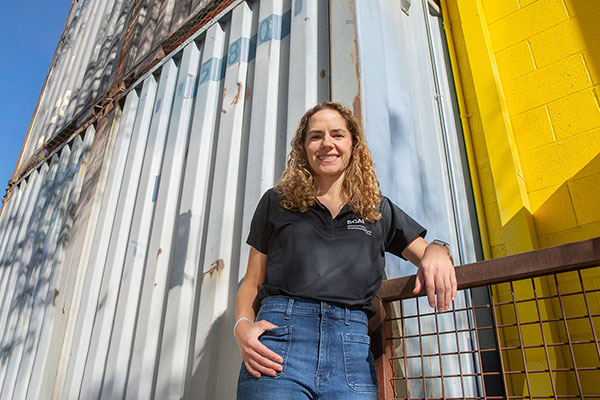
Article Image: Lacy Greening – image

Summary
Arizona State University assistant professor Lacy Greening has been named an ARPA-I semifinalist for a proposal that uses agentic AI to make the US freight system — especially the middle mile — more resilient and cost-efficient. Her approach replaces today’s fractured, sequential planning tools with many smaller AI agents that reason locally, coordinate globally and adapt in real time, allowing the network to anticipate disruptions rather than only react to them.
The proposal outlines a three-tier framework: data-ingesting agents at the base, planning agents that reroute and reschedule in the middle, and human oversight at the top. The aim is to cut cascading delays and expensive stop-gap fixes (air freight, extra drivers, overtime) by anticipating problems such as weather or labour shortages and adjusting resources across fulfilment centres, hubs and warehouses.
Key Points
- Lacy Greening was chosen from 448 submissions as an ARPA-I semifinalist for an AI-driven middle-mile solution.
- Current freight planning is sequential and siloed; Greening proposes many smaller, agentic AIs that communicate and coordinate in real time.
- The middle mile — transfers between warehouses, fulfilment centres and regional hubs — is the most complex and cost-heavy segment of freight.
- Her three-tier framework: continuous data ingestion, local optimisation and planning agents, and human oversight for high-stakes decisions.
- Goal is to prevent disruptions (e.g. reroute ahead of a snowstorm) to reduce cascading delays and expensive mitigation measures.
- Work is collaborative (Purdue co-investigator) and builds on Greening’s industry experience with The Home Depot and Amazon.
Context and Relevance
Freight networks are increasingly strained by extreme weather, labour volatility and demand spikes. This research is timely because it targets the middle mile — where consolidation and transfers create complexity and cost — and introduces an architecture that fits with trends towards decentralised, real-time decisioning and autonomous agents in logistics. If successful, the approach could change how carriers, 3PLs and shippers plan daily operations and invest in digital infrastructure.
Why should I read this?
Because it’s one of those smart, practical ideas that could actually save your operation time and money. Greening isn’t theorising from an ivory tower — she’s built models in industry and now wants freight systems that don’t wait for disaster to act. If you care about fewer delays, lower emergency spend and smoother coordination across hubs, this is worth a quick read.
Author style
Punchy: the piece flags a concrete, high-impact research direction. If the project scales, it’s the kind of systems-level change that could move the needle on resilience and costs across the sector — so read the detail if you manage networks or tech strategy.
Source
Source: https://www.supplychain247.com/article/ai-middle-mile-freight-disruption-arpa