
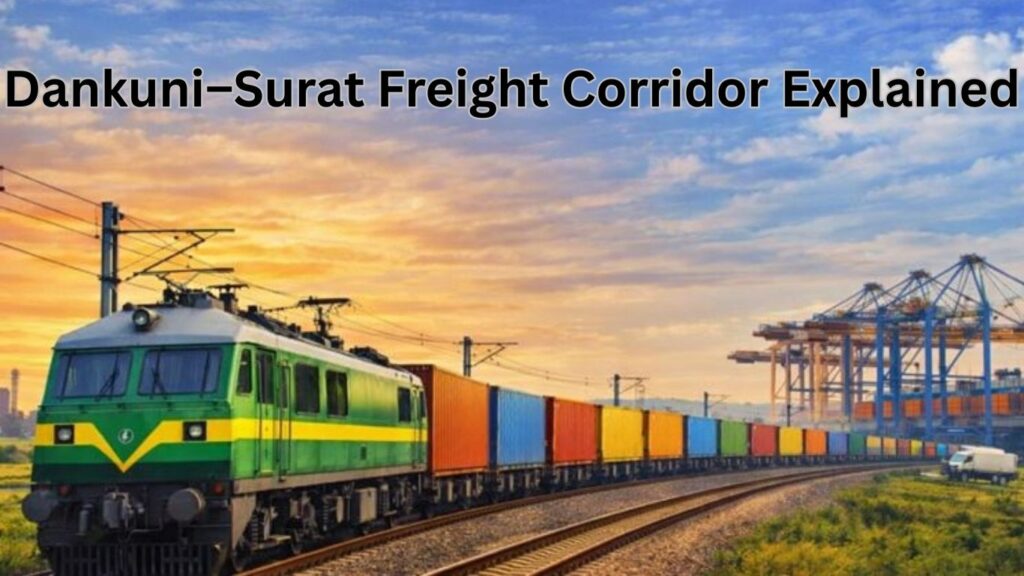
Budget 2026: Dankuni–Surat Freight Corridor Explained
Summary
The Union Budget 2026 announced a new Dedicated Freight Corridor (DFC) running from Dankuni (West Bengal) to Surat (Gujarat). Spanning roughly 2,052 km and cutting across Odisha, Chhattisgarh, Madhya Pradesh and parts of Maharashtra, the corridor is designed as an east–west freight spine to speed up heavy-haul traffic, improve connectivity to west-coast ports and support greener, more reliable cargo movement.
Key Points
- Proposed length: about 2,052 km linking Dankuni to Surat through key industrial states.
- Designed for heavy-haul operations: target speeds up to 100 km/h and axle loads around 32.5 tonnes.
- Will move bulk commodities (coal, steel, foodgrains) more efficiently, shortening transit times and cutting freight costs.
- Integrates with the Eastern DFC and Western DFC to create a continuous national freight grid and improve export connectivity to Maharashtra and Gujarat ports.
- Aims to decongest existing lines, shift modal share from road to rail, and boost supply-chain resilience for eastern and western industrial belts.
- Forms part of a larger rail capital expenditure push (~₹2.77 lakh crore) and wider infrastructure measures to encourage greener freight and coastal waterways.
Content summary
The article explains the Dankuni–Surat corridor as a strategic east–west addition to India’s Dedicated Freight Corridor network. Railway officials expect the line to enable heavy-duty trains at higher speeds and axle loads, making rail more competitive versus road for bulk cargo. The corridor will dovetail with the existing Eastern and Western DFCs, creating a continuous freight route that links eastern production hubs to west-coast ports, easing export flows and reducing logistics friction.
Beyond operational benefits, the corridor is pitched as an economic catalyst: faster and cheaper freight will encourage manufacturing and logistics-led development along the route, with Dankuni anticipated to grow as a major logistics hub.
Context and relevance
This announcement is significant for logistics, manufacturing and port authorities because it completes a long-awaited east–west freight axis, complementing India’s north–south freight structure. It aligns with ongoing policy trends — higher rail capex, modal shift to greener transport and multimodal connectivity — and directly affects regional supply chains, export competitiveness and industrial location decisions across multiple states.
Author style
Punchy: this isn’t a small tweak — it’s a structural shift. If you deal with freight, ports, manufacturing or regional planning, you should read the detail because the corridor will change where goods move, how fast they move and how competitive exports from eastern India can be.
Why should I read this?
Quick heads-up: if your business ships bulk materials or relies on east–west trade routes, this Budget move will matter. It could cut your transit times and costs, open new markets, and reshape where logistics hubs crop up. Read on if you want to know how supply chains and port links might change in the next few years.
Source
Source: https://www.logisticsinsider.in/budget-2026-dankuni-surat-freight-corridor-explained/