
New Health Information Bill in Singapore moves to close care gaps as patients navigate more healthcare providers
Summary
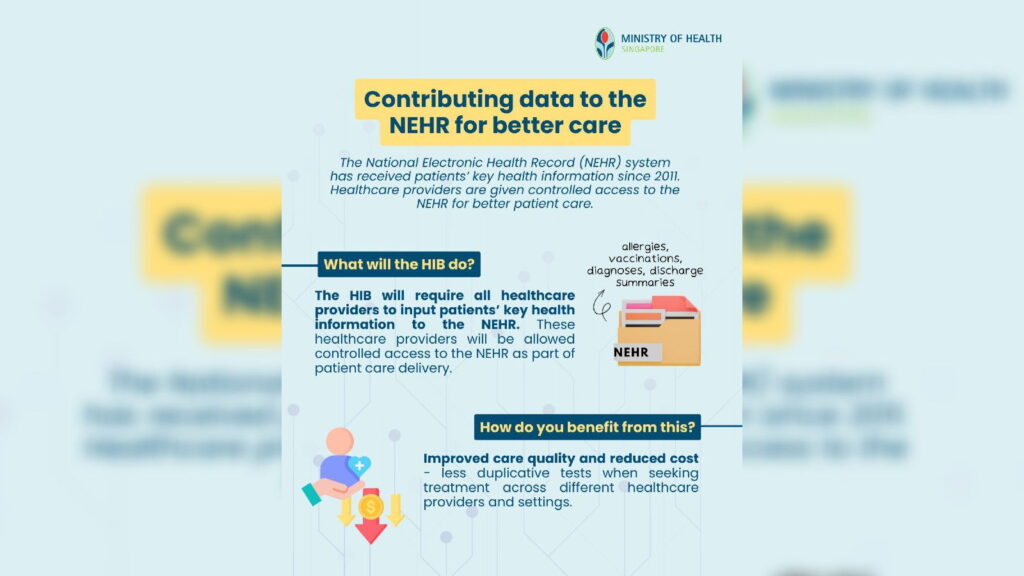
The Health Information Bill (HIB), passed in Parliament on 12 January 2026, requires all licensed healthcare providers in Singapore to share key patient information via the National Electronic Health Record (NEHR). The move aims to close information gaps as care shifts from acute hospitals into community and home settings, improving continuity and safety of care for an ageing population with more chronic conditions. Access to NEHR is restricted to healthcare professionals directly involved in care, with legal safeguards, audits, penalties, patient visibility via HealthHub and emergency ‘break glass’ access where necessary. The Bill also provides a legal basis for sharing selected non-NEHR information to support community programmes and mandates cybersecurity and breach-notification standards. Implementation is planned from early 2027, with training and support for providers.
Key Points
- The HIB makes it mandatory for all licensed healthcare providers to contribute key patient data (allergies, medications, diagnoses, lab results, radiology, immunisations, discharge summaries) to the NEHR.
- Access to NEHR is limited to healthcare professionals directly involved in a patient’s care; use for employment or insurance is prohibited (with narrow legal exceptions).
- Patients can view who accessed their records via HealthHub, can report unauthorised access and may place access restrictions; essential safety data (eg allergies, vaccinations) remain available even with restrictions.
- An emergency ‘break glass’ function allows clinicians to access records when clinically necessary despite restrictions, with oversight and audits to deter misuse.
- The Bill provides for lawful sharing of non-NEHR information to support community health initiatives (eg Agency for Integrated Care outreach under Healthier SG and Age Well SG).
- Contributors and users of health data must meet cybersecurity and data security standards and notify MOH of confirmed breaches; penalties and audits are strengthened.
- HIB is intended to take effect from early 2027, with guidance, training and funding support to help providers comply.
Context and relevance
Singapore’s care model is shifting towards community and home-based services to meet the needs of an ageing population and rising chronic disease prevalence. As patients see more GPs, specialists and community providers, fragmented records raise risks of medication errors, duplicated tests and delayed treatment. The HIB addresses these system-level risks by ensuring core clinical information follows patients across providers, supporting coordinated, safer, and potentially more cost-effective care. For employers, HR teams and insurers, the Bill clarifies that NEHR data cannot be used for employment or insurance purposes, reducing the risk of inadvertent misuse of clinical information.
Why should I read this?
Short answer: because it changes who can see clinical records, what data must be shared, and how breaches are handled — and that affects patient safety, data privacy and how clinics and community services work together. If you manage staff health policies, vendor contracts, or work in healthcare, this will hit your day-to-day. We read it so you don’t have to.
Author style
Punchy: this is a consequential legal change that tightens data-sharing rules while aiming to plug dangerous gaps in care. If you handle health data, benefits or compliance, pay attention to the 2027 rollout and the obligations on providers.