
Malaysia’s unemployment rate falls to 2.9% in November 2025, lowest in 11 years: DOSM
Summary
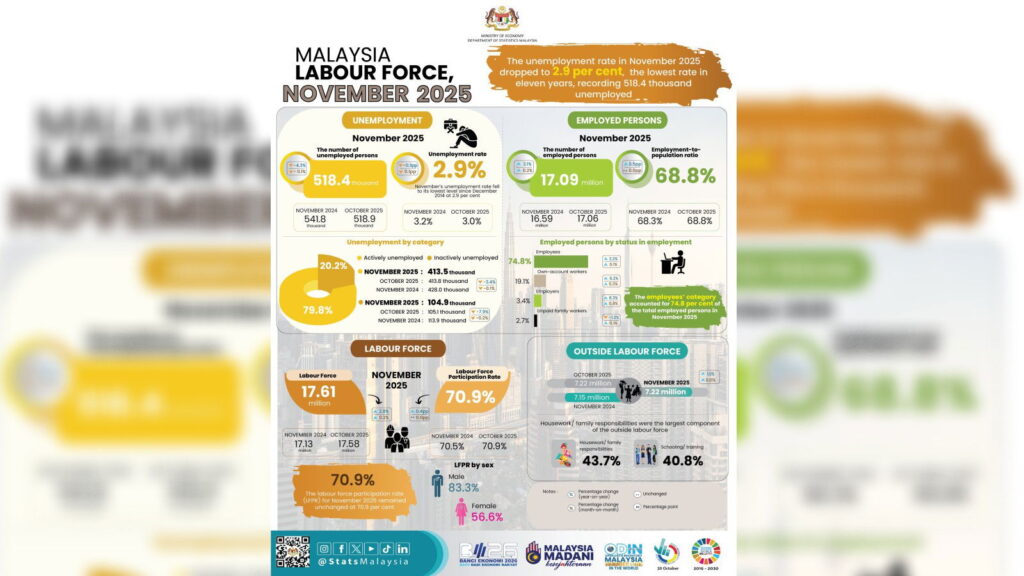
Malaysia’s unemployment rate dropped to 2.9% in November 2025 — the lowest since November 2014 — according to the Department of Statistics Malaysia (DOSM). That figure corresponds to 518,400 unemployed persons, with the labour force rising to 17.61 million and the labour force participation rate holding at 70.9%.
Employment edged up to 17.09 million (a 0.2% monthly increase). Employees made up 74.8% of employment; own-account workers also rose slightly. Services-led growth (health, social work, wholesale & retail, accommodation and F&B) underpinned gains, alongside increases in agriculture, manufacturing, construction and mining & quarrying.
Key Points
- Unemployment rate fell from 3.0% in October to 2.9% in November 2025 — lowest in 11 years (518,400 unemployed).
- Labour force increased 0.2% month-on-month to 17.61 million; participation rate steady at 70.9%.
- Employed persons rose 0.2% to 17.09 million; employees accounted for 74.8% of employment.
- Services sector continued to drive employment growth, notably health, retail and hospitality.
- Shorter working hours increased: persons working <30 hours/week rose to 237,000; time-related underemployment rose to 129,900 (0.8%).
- 79.8% of unemployed were actively seeking work; 64.4% of active jobseekers had been unemployed for under three months.
- Youth unemployment: 15–24 rate at 10.1% (297,900 persons); 15–30 rate at 6.1% (398,000 persons).
- DOSM expects the labour market to remain stable, supported by job creation in strategic industries and reskilling/upskilling efforts.
Content summary
DOSM’s Labour Force Survey shows a tightening labour market in Malaysia as of November 2025. While headline unemployment has fallen below 3%, the report flags underemployment and shorter working hours as areas to watch. The services sector is the main employment engine, complemented by growth in traditional sectors such as agriculture and manufacturing. Youth unemployment remains higher than the national average but stable month-on-month.
Looking ahead, policymakers and employers expect continued stability driven by strategic industry jobs, skills development programmes and efforts to balance regional development — measures intended to broaden opportunities, including in rural areas.
Context and relevance
This is important for HR leaders, recruiters and policymakers: a sub-3% unemployment rate signals a tighter labour market that can push up recruitment difficulty and wage pressures. It also highlights where hiring is strongest (services, health, retail, hospitality) and where underemployment could mask capacity constraints despite low unemployment.
Why should I read this?
Short version: hiring’s getting tougher in Malaysia. If you recruit, plan workforce budgets or run skills programmes, this gives you the key numbers and what sectors to watch — fast.
Author style
Punchy: this is a meaningful labour-market shift — low headline unemployment but some underemployment and shorter hours. Read it if hiring, retention or workforce planning in Malaysia matter to you; it’s a snapshot that affects recruitment strategy, pay budgets and training priorities.