
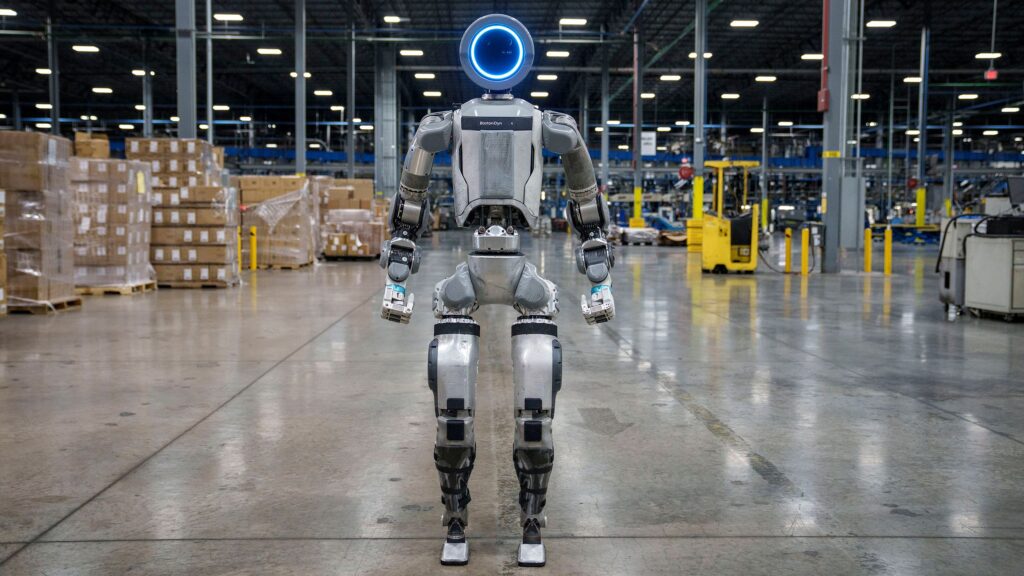
Google Gemini Is Taking Control of Humanoid Robots on Auto Factory Floors
Summary
Google DeepMind has partnered with Boston Dynamics to integrate the Gemini Robotics model into Boston Dynamics’ robots, including the humanoid Atlas and the quadruped Spot. Announced at CES 2026, the collaboration will begin trials at Hyundai auto factories in the coming months. The move aims to give humanoid robots better contextual awareness and manual dexterity so they can identify, navigate and manipulate unfamiliar objects in real-world industrial settings.
Key Points
- Google DeepMind will deploy its Gemini Robotics model on Boston Dynamics platforms such as Atlas and Spot.
- Trials are planned at Hyundai-owned auto factories, signalling an early industrial deployment focus.
- The goal is to add contextual awareness and improved manipulation so humanoids can handle unfamiliar objects and environments.
- Boston Dynamics and DeepMind expect robot sensor data to further train and improve Gemini’s physical-world capabilities.
- The collaboration highlights an industry trend where large AI models are being paired with robotics hardware to produce ‘physical intelligence’.
- Safety is a major concern: Gemini will add an extra layer of reasoning to preempt and prevent dangerous behaviours alongside existing safety systems.
Content Summary
Atlas already demonstrates impressive agility, from dance moves to acrobatics, but lacks the intelligence to understand and manipulate objects in complex factory contexts. By embedding Gemini, DeepMind and Boston Dynamics hope to supply that missing cognitive layer — a multimodal model that can interpret vision, sensor and contextual cues and translate them into safe, reliable physical actions. The partnership is part of broader industry momentum: many firms worldwide are racing to combine advanced AI with humanoid hardware, from startups to major players like Tesla and OpenAI.
The companies emphasise that automotive manufacturing is a pragmatic starting point because of repetitive but varied manual tasks. Data gathered during these trials will feed back into Gemini, improving its real-world reasoning. However, the article stresses open questions remain about how well AI-driven robots can match human subtlety in manipulation and the critical need to guarantee human safety on factory floors.
Context and Relevance
This is a significant development in both AI and robotics: it shows major AI models moving beyond screens and into physical systems that operate in the real world. For manufacturers, it points to potential labour augmentation or replacement in routine manual roles, faster task onboarding for robots, and new operational models where software updates improve fleet capability. For the AI industry, it accelerates the feedback loop between embodied data and model training — potentially speeding progress towards robots with broader, general-purpose skills.
At the same time, it raises regulatory, safety and workforce questions. Ensuring reliable safeguards and transparent operational limits will be essential if humanoids are to be trusted in environments shared with human workers.
Why should I read this?
Because this is where sci-fi starts turning into factory reality — Google’s big-model smarts are being plugged into real robots and tested on car production lines. If you care about how AI will change manufacturing, jobs, or safety on the shop floor, this is one of the clearest early signals. Short version: pay attention now — things could move fast.
Author style
Punchy: this story matters. It’s not just another demo — it marks a step toward AI that controls physical systems at scale. Read the detail if you want to understand the technical promise, industrial plans, and safety caveats that will shape how quickly and widely humanoid robots are adopted.
Source
Source: https://www.wired.com/story/google-boston-dynamics-gemini-powered-robot-atlas/