
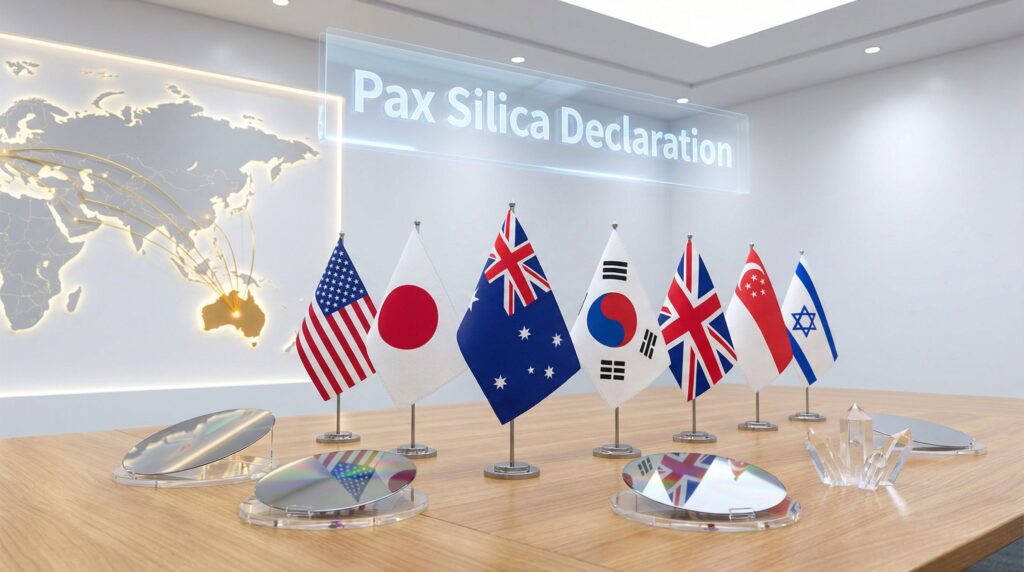
Why India Must Secure a Seat at the Pax Silica Table
Summary
The article argues that Pax Silica — the US-led coalition to build a resilient, trusted global semiconductor supply chain — is strategically important for India. India was initially excluded from the nine-nation group, but recent US statements indicate talks are underway for Indian membership, possibly concluding in early 2026. The piece sets out why India must push to join: semiconductors are critical to modern economies and national security, and membership brings coordinated investment, research, technology transfer and geopolitical weight. It also outlines India’s strengths (large market, mineral reserves) and recommends steps India should take to be a credible co-producer rather than just a consumer.
Key Points
- Pax Silica is a US-led effort to create a resilient, allied semiconductor supply chain in response to geopolitical competition.
- India was initially left out of the nine-nation bloc, a strategic gap that risks relegating India to a buyer role, not a co-creator.
- Membership offers more than parts access: coordinated investment flows, research partnerships, policy alignment and tech transfer.
- India has advantages — a 1.4bn population, fast-growing electronics market and reserves of critical minerals — that could be better leveraged within the alliance.
- To secure a meaningful seat India must scale up domestic fabrication, strengthen IP and investment frameworks, and deepen targeted bilateral/trilateral tech ties.
Context and Relevance
Semiconductors are foundational to everything from consumer devices to defence and AI. The CHIPS and Science Act accelerated US domestic investment and allied coordination; Pax Silica extends that model into an international governance and supply-chain framework led by trusted partners. For policymakers, industry leaders and investors in India, the article explains why participation in these alliances will shape access to technology, investment and the rules governing advanced semiconductor flows for the next decade.
Why should I read this?
Short answer: if you give a toss about India’s tech future, trade leverage or defence supply security — read this. It’s a quick, no-nonsense run-through of why not being at the Pax Silica table would cost India influence, investment and control over critical parts of the digital economy. Handy if you want the strategic punchlines without wading through policy white papers.
Author style
Punchy: the piece is direct and urgent — it pushes the point that India must act now to move from market to maker in the semiconductor era. If you’re into policy or corporate strategy, it signals high-stakes choices ahead and why the details matter.
Actionable next steps the article recommends
- Accelerate domestic capability: fabs, design centres and materials processing.
- Build investor-friendly, IP-secure policies that reassure allied partners on tech sharing.
- Deepen targeted bilateral and trilateral partnerships to complement multilateral entry.
- Leverage critical-mineral reserves to attract upstream and downstream investment.
- Present India as a co-producer and innovator, not merely a large consumer market.
Source
Source: https://www.logisticsinsider.in/why-india-must-secure-a-seat-at-the-pax-silica-table/