
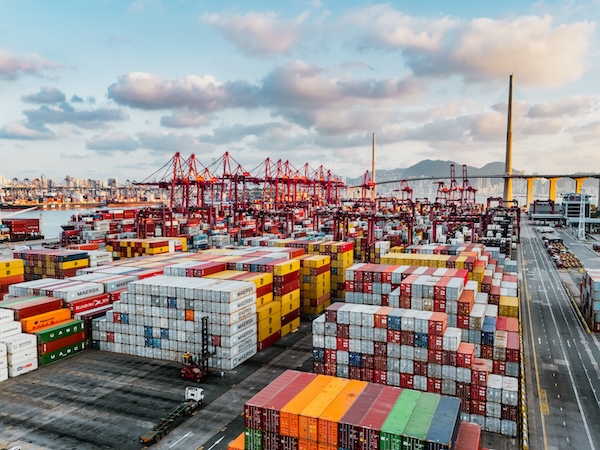
U.S.-bound container imports are expected to see declines through year end and into 2026, reports Port Tracker
Summary
The National Retail Federation and Hackett Associates’ latest Global Port Tracker shows U.S.-bound container volumes peaking near-record levels over the summer but heading into steady declines through the rest of 2025 and into early 2026. The report links the slowdown chiefly to rising and reciprocal tariffs, an early 2025 peak season, and inventory pull-forward ahead of tariff effective dates.
July imports (the most recent official month) were recorded at 2.36 million TEU (excluding New York/New Jersey, Port Everglades and Miami) — the second-highest month on record — but Port Tracker’s projections for August through January show progressively lower monthly TEU and double-digit annual declines by late 2025.
Source
Key Points
- Port Tracker (NRF + Hackett) forecasts falling U.S.-bound container volumes through year-end and into Jan 2026, largely driven by tariff actions and earlier-than-usual peak-season activity.
- July 2025 imports were 2.36 million TEU (second-highest on record), reflecting importers stocking up ahead of tariff increases.
- Monthly projections (Port Tracker): Aug 2025 2.28M TEU (-1.7% yr/yr); Sep 2.12M (-6.8%); Oct 1.95M (-13.2%); Nov 1.74M (-19.7%); Dec 1.70M (-20.1%); Jan 2026 1.80M (-19.1%).
- First half 2025 volumes totalled 12.53M TEU (+3.5% yr/yr); calendar-year 2025 is forecast to finish down ~3.4% to 24.7M TEU.
- Tariff developments: reciprocal tariffs took effect 1 August; a federal appeals court found IEEPA usage unlawful but tariffs remain while appeals continue; planned additional U.S. tariffs on China were delayed to 10 November; India tariffs rose (total U.S. tariff on India now ~50%).
- Retailers pulled inventory forward to beat tariff dates, but ongoing tariff uncertainty is undermining long-term planning and is likely to increase costs for consumers.
- Hackett warns shipping lines are revising forecasts and many expect a swing toward losses in Q4 due to reduced trade and excess vessel capacity.
Why should I read this?
Short version: if you move goods, sell products or plan capacity, this matters. Tariffs aren’t just political noise — they’re shifting volumes, squeezing margins and changing when and how retailers import. The report gives concrete month-by-month TEU projections you can use to stress-test capacity, labour and inventory plans.
Author’s take
Punchy and to the point: Port Tracker is signalling a clear downturn after a stacked summer. That spike was largely timing-driven; what follows is tariff-driven uncertainty. Supply-chain and logistics teams should be reworking forecasts, checking contracts and preparing for softer ocean demand into early 2026.