
The Most Important AI Question For CEOs
Summary
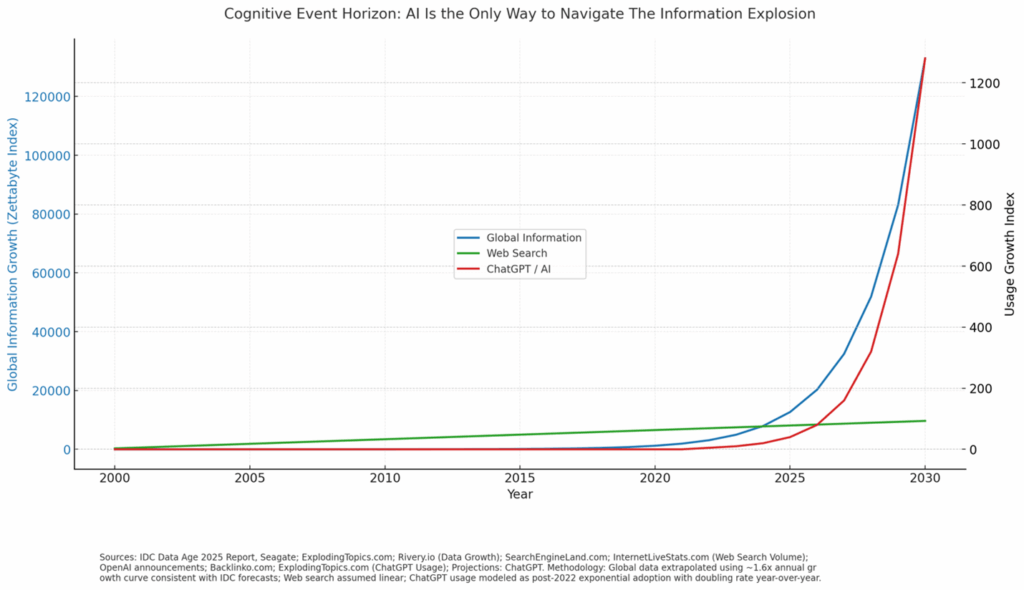
Dan Bigman argues that CEOs should stop asking whether to explore AI and start asking how to help people “think with AI.” He warns we are approaching a “cognitive event horizon” where unaided humans cannot keep pace with exploding data volumes (from ~2 exabytes in 2000 to an expected 180 zettabytes), making AI an interface layer for human cognition rather than just a productivity tool. AI both helps manage complexity and accelerates it by creating more data, producing a recursive feedback loop. Bigman offers a set of high-level questions leaders should pose to understand strategic, organisational and cultural impacts.
Key Points
- We may be nearing a “cognitive event horizon”—an information overload point where humans need AI as a thinking partner to keep up.
- Data growth is vast and accelerating (example: ~2 exabytes in 2000 to ~180 zettabytes expected), outpacing traditional ways to manage information.
- AI is shifting from a mere tool to an interface layer that translates, navigates and augments human thought.
- Using AI creates more data and complexity, producing a recursive, self-reinforcing feedback loop.
- CEOs must move from debating adoption to redesigning work: how to help people think with AI and restructure roles for cognitive abundance.
- Key concerns include competitive moats, trust in AI-generated insights, role design, training to ask better questions, and second-order effects of AI acceleration.
- Bigman provides a list of practical questions for leadership to start internal conversations immediately.
Context and Relevance
This piece matters because it reframes AI from a technology project to a leadership and cultural challenge. For executives, the implications touch strategy (are your moats still durable?), talent and organisational design (how roles and reviews change), risk and governance (maintaining trust in AI-mediated decisions), and capability-building (training people to think with AI). The article connects current trends in data explosion and rapid AI uptake (e.g., mass user adoption of LLMs) to urgent strategic choices for firms of all sizes.
Why should I read this?
Short answer: because this isn’t another how-to on tools — it’s a wake-up call for leaders. If you want a quick, sharp framework to start the right conversations with your exec team (not techies), this is it. It gives you the questions to ask now so you don’t get left redesigning the business later when cognitive expectations have already shifted.
Author style
Punchy and urgent. Bigman keeps the piece high-level but consequential — the kind of short brief you can share with your leadership team to spark immediate debate. If you care about strategy or organisational design, read the article and use the questions as a meeting agenda.
Key questions to take to your team
- Are our competitive moats based on proprietary ideas, and how does near-zero cognitive cost affect them?
- What could we achieve if every employee had an AI thinking partner — and what happens if our competitors adopt that model first?
- Are we structuring roles, reviews and reporting for scarcity or for cognitive abundance?
- Where are people currently drowning in complexity rather than workload, and can AI help?
- How will trust and decision-making change when machines increasingly act as sense-makers?
- How do we train people to think with AI, not just use it — to ask better questions, not only get faster answers?
- What second-order effects of AI acceleration are we underestimating?
Source
Source: https://chiefexecutive.net/the-most-important-ai-question-for-ceos/